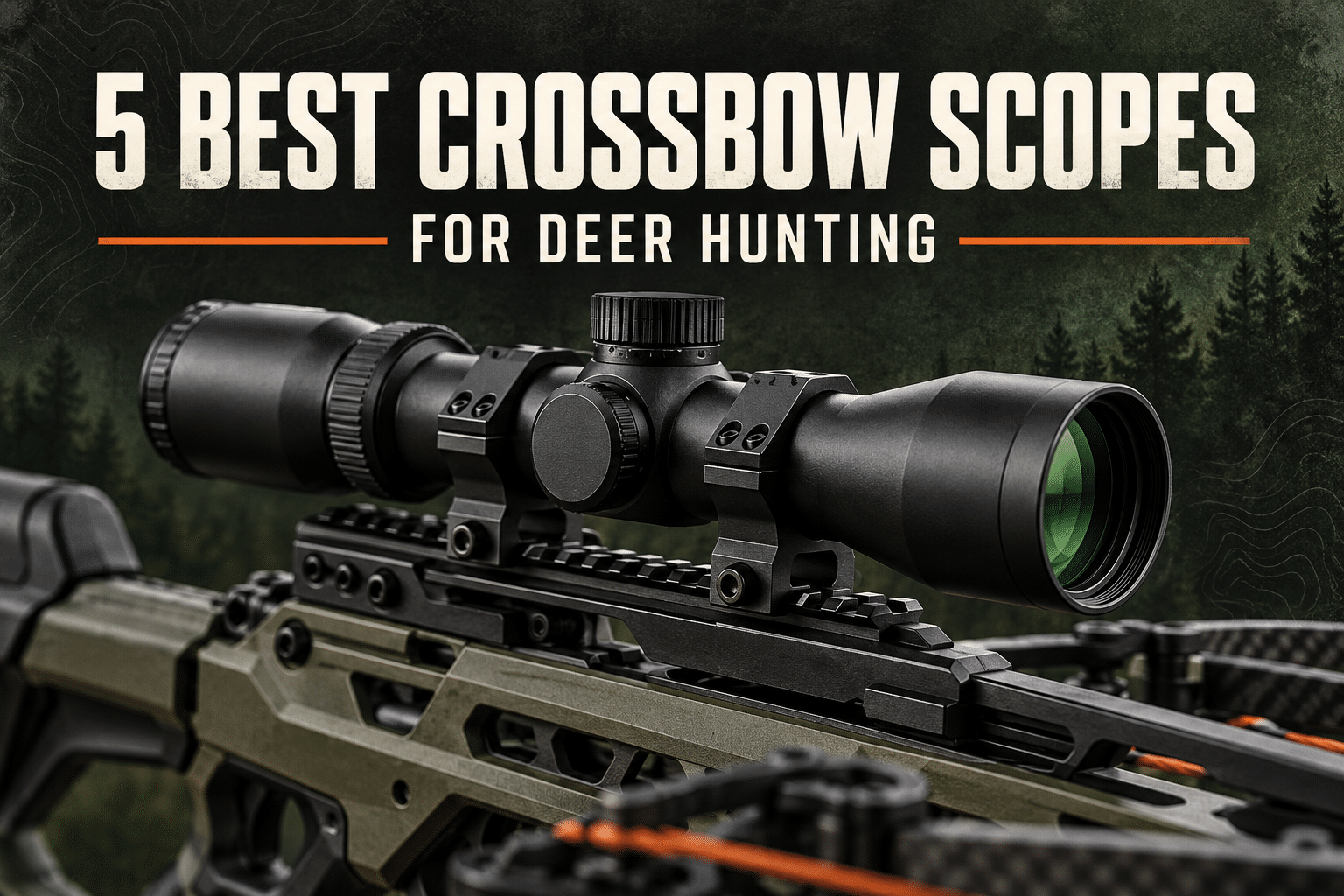
A Better Scope for the Way You Hunt Deer
Five picks for five priorities: an all-around upgrade, everyday value, premium rangefinding, a sub-$100 budget, and more affordable onboard ranging.
A deer can step into your shooting lane with little warning. That is when the scope on your crossbow needs to feel familiar: a clear aiming reference, a comfortable view, and a hold you have already checked with your hunting arrows. An impressive feature list matters less than knowing exactly what you see when you settle behind the stock.
Our picks for the best crossbow scopes for deer hunting cover the choices most hunters face. The Hawke XB30 Zoom earns our best overall recommendation for a compatible setup. The Vortex Crossfire II Crossbow is our value pick, while the Garmin Xero X1i takes the premium rangefinding category. The CVLIFE 1.5–5×32 keeps the budget in focus, and the BUK OPS X-Factor offers a less expensive route to integrated ranging.
Jump to: Top picks · Which should you buy? · How we chose · Reviews · Buying guide · FAQs
Picks at a Glance
Compare each scope’s aiming system and price below.
Hawke XB30 Zoom
Our pick: Best Overall
Optic: 2–8×36 FFP model
Rangefinding: No built-in laser
Price: Check current offer
Vortex Crossfire II Crossbow
Our pick: Best Bang for the Buck
Optic: 2–7×32
Rangefinding: No built-in laser
Price: $279.99 manufacturer MSRP; retailer offers vary
Garmin Xero X1i
Our pick: Best Rangefinding
Optic: Fixed 3.5x
Rangefinding: Built-in laser with a calculated aiming point after calibration
Price: Check current offer
CVLIFE 1.5–5×32
Our pick: Best Under $100
Optic: 1.5–5×32
Rangefinding: No built-in laser
Price: Verify the selected offer is below $100
BUK OPS X-Factor
Our pick: Best Rangefinding Scope for the Price
Aiming system: Speed-calibrated reticle
Rangefinding: Built-in laser; you select the appropriate reticle hold
Price: $599.99 manufacturer sale price at our October 2, 2026 check; offers vary
Prices and availability can change. Confirm the exact model, included accessories, and compatibility before purchasing.
Which Crossbow Scope Should You Buy?
- You want an all-around conventional upgrade: Start with the Hawke XB30 Zoom, provided its speed-specific configuration suits your hunting-arrow setup.
- You already own a rangefinder: The Vortex Crossfire II Crossbow is the first value option we would compare. Put the remaining budget toward arrows, broadhead practice, or a better rest.
- You want a range reading and a calculated aiming point: Choose the Garmin Xero X1i if you are comfortable learning an electronic system.
- Your scope budget stops at $100: Compare the current CVLIFE 1.5–5×32 offer, then leave yourself enough time for a thorough setup and practice session.
- You want integrated ranging at a lower price tier: Look at the BUK OPS X-Factor. You still use the appropriate reticle reference after ranging.
How We Chose These Scopes
We organized this shortlist around five buying priorities: overall versatility, conventional-scope value, premium rangefinding, a tight budget, and the price of onboard ranging. Our recommendations combine published manufacturer information with an editorial assessment of how each aiming system fits deer hunting. This is a buying guide, not a claim that all five scopes underwent a side-by-side field test.
We gave particular attention to reticle use, trajectory calibration, shopping compatibility, and the amount of equipment handling each option requires. “Best overall” means our preferred starting point within this shortlist for a compatible hunting setup. A hunter who values simplicity above adjustable magnification may reasonably choose the Vortex instead.
The Best Crossbow Scopes for Deer Hunting
Best Overall: Hawke XB30 Zoom

A versatile conventional scope for a compatible crossbow
The Hawke XB30 Zoom is our best overall pick because it gives a deer hunter a useful way to change the view without tying every magnification change to a different reticle calibration. The FFP 2–8×36 version uses a first-focal-plane reticle: its proportions scale with magnification, preserving the angular relationship between the aiming references.
That flexibility appeals to hunters who split time between a tight wooded stand and a more open shooting lane. You can favor a lower-power view for a close encounter and increase magnification for a clearer look at a target during practice. The value is being able to choose the view that fits the moment after establishing your holds.
The important purchase decision is the speed-specific version. Hawke offers the Zoom FFP family in different arrow-speed bands. Match the model to your actual hunting-arrow velocity and follow its setup instructions; a first-focal-plane reticle does not make an unsuitable trajectory match disappear.
What we like
- FFP design preserves reticle subtensions as you zoom.
- Red/green illumination provides a choice of aiming-reference color.
- A useful overall option when independent zoom adjustment matters.
What to consider
- The speed-specific model must suit your arrow setup.
- No built-in laser rangefinder.
- The reticle appears smaller at lower magnification.
Who should buy it: Choose it if you want a conventional scope with flexible zoom and are willing to get the model match and calibration right. If your arrow speed falls outside the available bands, compare another optic rather than forcing the fit.
For a closer look, read the Hawke XB30 Zoom FFP crossbow scope review.
Best Bang for the Buck: Vortex Crossfire II Crossbow
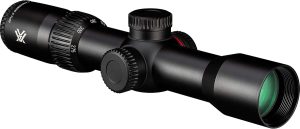

A practical upgrade without the rangefinding premium
The Vortex Crossfire II Crossbow is our best bang-for-the-buck pick for hunters who already have a workable way to measure distance. Its 2–7×32 configuration, illuminated XBR-2 reticle, and included mounting accessories make it a straightforward package to compare against a basic bundled scope.
Vortex lists the Crossbow Kit with a 30mm tube, a 14-ounce scope weight, red/green illumination, rings, flip caps, and a protective cover. Those details give you a clearer picture of the complete purchase than magnification alone. Confirm that the supplied ring height works with your crossbow and shooting position.
Pay attention to the magnification/FPS ring when calibrating. This is a second-focal-plane scope, so changing power can change how its references correspond to arrow drop. Follow the manual and confirm your holds instead of treating it like an unrestricted zoom control after sighting in. Also select the crossbow-specific model; the Crossfire II name covers other optics.
What we like
- A complete kit makes the initial shopping decision simpler.
- Illumination and multiple holds suit a conventional hunting workflow.
- Vortex lists lifetime warranty coverage.
What to consider
- You still need a separate rangefinder or established lane distances.
- Changing magnification can affect calibrated holds.
- Included rings are not a guarantee of ideal fit on every crossbow.
Who should buy it: Choose it when you want a useful conventional hunting upgrade and would rather spend the rest of your budget on practice than onboard electronics.
Best Rangefinding: Garmin Xero X1i
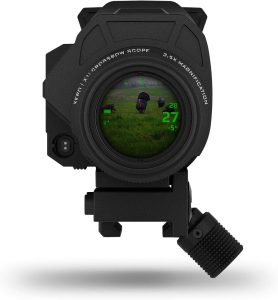

The premium pick for a calculated aiming point
The Garmin Xero X1i earns our best rangefinding award because it combines distance measurement with an electronic aiming solution. After setup and calibration, it uses a built-in laser and digital overlay to supply a calculated aim point for the ranged distance. Its optical magnification is fixed at 3.5x.
The appeal is a more integrated sequence: look through the scope, activate ranging, and use the displayed aiming solution. Garmin provides both an on-scope control and a wired trigger option. A hunter who finds separate rangefinder handling awkward may value that workflow more than another hunter who already ranges every lane before sitting down.
The tradeoff is learning the system. Spend time on its menus, calibration, display behavior, and controls before hunting. Use the prescribed batteries and practice with the same arrows and broadheads you intend to carry. Electronics can simplify a practiced routine, but discovering an unfamiliar setting when a deer appears defeats the purpose of the upgrade.
What we like
- Built-in ranging and a calculated aim point work together.
- Fixed 3.5x magnification keeps the optical view consistent.
- A wired trigger offers another way to activate ranging.
What to consider
- A premium purchase compared with conventional options.
- The electronic aiming workflow requires setup and practice.
- Battery readiness becomes part of hunt preparation.
Who should buy it: Choose it if the calculated aiming solution is the feature you actually want. If you only want a range number through the optic, compare the less expensive X-Factor before committing.
Best Under $100: CVLIFE 1.5–5×32

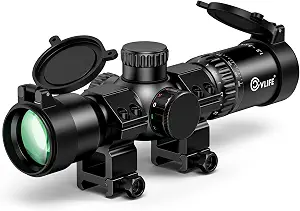
A budget-first option for a basic hunting setup
The CVLIFE 1.5–5×32 is our best-under-$100 pick when the offer you select meets that price ceiling. The manufacturer describes a crossbow-specific scope with red/green illumination, a speed-calibrated magnification ring, and included rings and lens caps. Verify the exact configuration in the linked listing before buying.
Its role in this guide is simple: give a hunter with a limited budget a conventional option to compare. A low purchase price can be useful on an older crossbow, a backup setup, or a build where other necessary equipment has already consumed most of the budget. It does not remove the need for a careful range session.
Inspect the mounting arrangement, establish zero, and check the relevant aiming references with your hunting arrows. Repeat enough shots to judge consistency, then practice from your hunting position. Budget room is only useful if the final setup gives you confidence you have earned on the target.
What we like
- A candidate for a strict sub-$100 scope budget.
- Includes illumination and multiple aiming references.
- Mounting accessories are listed in the package.
What to consider
- The under-$100 award depends on the actual current offer.
- There is no integrated laser rangefinder.
- Magnification and trajectory calibration require attention.
Who should buy it: Choose it when price is the firm limit and you can devote time to verifying the finished setup. If the listing price climbs above $100, reassess the value against other conventional scopes.
Best Rangefinding Scope for the Price: BUK OPS X-Factor
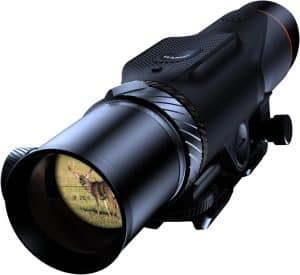

Onboard ranging for hunters watching the price
The BUK OPS X-Factor is our best rangefinding scope for the price within this five-scope shortlist. It combines a built-in angle-compensating laser rangefinder with a speed-calibrated reticle. At our price check, BUK OPS listed a $599.99 sale price against a $699.99 regular price; retailer offers may differ.
The distinction from the Garmin matters: the X-Factor gives you the range reading, then you select the appropriate verified reticle hold. Its product description lists red/green illumination and an active scan mode. That makes it an option for hunters who want to reduce separate rangefinder handling while retaining a familiar multi-reference aiming method.
Think about that sequence before choosing it. Do you prefer seeing several references and choosing your hold, or do you want the scope to present a calculated aiming point? The X-Factor fits the first preference. Learn the control placement and confirm each reference during practice so the lower purchase price does not come with an unfamiliar shot routine.
What we like
- Integrated ranging at a lower price tier than the premium Garmin option.
- Angle compensation is included in the ranging system.
- A conventional reticle workflow may feel familiar.
What to consider
- You select your hold after ranging.
- It still costs substantially more than a basic scope.
- The listed CR2 and CR1632 batteries are not included.
Who should buy it: Choose it when built-in ranging matters, but you are comfortable choosing the correct hold yourself. Compare the complete purchase cost, including batteries and any mounting needs.
For a closer look, read the BUK OPS X-Factor rangefinding crossbow scope review.
How to Choose a Crossbow Scope for Deer Hunting
Start with your actual shooting lanes
Think about the places where a deer can offer a clear, stationary shot from your stand. A scope should make those opportunities easier to manage. If you mostly hunt thick cover, an easy-to-use view and familiar reticle may matter more than maximum power. A large magnification number is a poor reason to change equipment on its own.
Understand what “rangefinding” means
A scope with distance references in its reticle is not necessarily equipped with a laser rangefinder. In this shortlist, Garmin and BUK OPS have built-in lasers. The Hawke, Vortex, and CVLIFE require another method of establishing distance. Garmin adds a calculated aiming point; BUK OPS leaves the hold selection to you. Decide which part of that process you want the optic to handle.
Match the reticle to your hunting arrows
Advertised crossbow speed is a starting point for shopping, not a substitute for checking your complete arrow setup. Use measured hunting-arrow velocity when possible, read the scope instructions, and verify impacts at the distances you plan to shoot. A labeled yardage reference deserves your confidence only after you have confirmed what it does with your arrows.
Know whether you can change magnification freely
Some crossbow scopes link magnification to the trajectory calibration. Once their holds are established, casually changing power can change the relationship between the marks and arrow drop. The Hawke Zoom FFP offers a different approach, but it still requires the correct model and verified trajectory match. Learn the rules for the particular optic you buy.
Treat illumination as an aiming aid
An illuminated reticle helps you see an aiming reference against a difficult background. It does not replace identifying the deer, checking the shooting lane, or being able to see where you intend the arrow to go. Practice choosing a comfortable brightness level and handling the controls before you take the scope hunting.
Budget for the complete setup
Check the rail, rings or bracket, eye relief, and the position of any ranging control. Mount the optic so you can shoulder the crossbow naturally without searching for the sight picture. Include any required batteries and mounting parts in your price comparison. A bargain stops being one if the installation leaves you struggling behind the stock.
Before You Take It Deer Hunting
- Mount the optic according to the crossbow and scope instructions, including the specified fastener torque.
- Establish zero and verify every hold you may use with your hunting arrows and broadheads.
- Practice from the positions you expect to use in a stand or blind.
- For an electronic optic, rehearse ranging, reading the display, and aiming until the sequence is familiar.
- Check batteries, caps, controls, and mounting hardware before heading out.
- Confirm current hunting rules for your location before using a laser or electronic aiming system.
- Set your hunting range from demonstrated accuracy and the conditions. Rangefinder reach and long-distance reticle marks do not establish an appropriate shot distance on a live deer.
Scope Care Between Hunts
Follow the manufacturer’s cleaning instructions and use a proper lens-cleaning method rather than wiping grit across the glass. Protect the lenses during transport, let wet equipment dry, and inspect the mount after a bump or fall. If something changes or the crossbow takes a hard knock, confirm zero before your next hunt. Keep spare batteries appropriate to your optic where you can find them.
Crossbow Scope FAQs
What is the best crossbow scope for deer hunting?
Our best overall pick in this shortlist is the Hawke XB30 Zoom FFP for a compatible arrow-speed setup. The Vortex Crossfire II Crossbow is our value recommendation, and the Garmin Xero X1i is our choice when a calculated rangefinding aim point is the priority.
Do I need a rangefinding scope to hunt deer?
No. A conventional scope paired with a separate rangefinder or verified lane distances can serve a deer hunter well. An integrated system is worth comparing when it makes your equipment routine easier to manage.
Does the X-Factor work the same way as the Garmin Xero X1i?
No. Both include laser ranging, but their aiming workflows differ. The Garmin supplies a calculated aim point after calibration. With the X-Factor, you use the range reading to choose your verified reticle hold.
Can I use a regular rifle scope on a crossbow?
Check compatibility with the crossbow and optic manufacturers. For this guide, we favor crossbow-specific models because their reticles and setup procedures are designed around crossbow trajectories. Do not assume a similarly named rifle model provides the same aiming references.
Is the CVLIFE 1.5–5×32 always under $100?
No price is guaranteed. Its award here is conditional on finding the specified crossbow scope below $100. Check the current offer, included accessories, and exact model before ordering.
How far should I shoot a deer with one of these scopes?
There is no distance that a scope alone can establish for you. Use your demonstrated accuracy with hunting arrows, the deer’s position and behavior, and the visibility and clearance of the lane. Pass a shot when any part of that decision is uncertain.
Our Recommendation
Start with the Hawke if you want an all-around conventional upgrade and your hunting arrows fit the appropriate model. Start with the Vortex if value and a familiar scope-plus-rangefinder routine matter most. Choose the Garmin for its calculated aiming solution, the CVLIFE for a strict budget, or the X-Factor for onboard ranging at a lower price tier. The right purchase is the one you can set up correctly and use confidently when a deer steps into your lane.
For additional scope categories and a broader equipment comparison, read Crossbow Magazine’s best crossbow scopes guide.