Big Buck Series • Kentucky • September 24, 2026
T.J. Graham had already seen his target buck on four hunts without getting a shot. He’d passed two other impressive bucks repeatedly, and the wait was wearing on him. On his 14th consecutive afternoon sit, a 40-yard opportunity finally brought the two-week pursuit to a close.
Jump to the Story
The Buck at a Glance
Hunter
T.J. Graham
Reported Score
171 3/8 inches
Age
5½ years old
Harvest
Sept. 24, 2026
Kentucky • Bow
Four Encounters Without a Shot
Graham and his hunting companions began getting trail-camera photos of the mature buck around Labor Day weekend. The 5½-year-old continued appearing in the days and weeks that followed, giving Graham a deer to focus on as the early season unfolded.
Once he started hunting, Graham saw the buck in person on four separate sits. Each encounter ended the same way: the deer was either out of range or it was too dark to shoot.
Graham had killed good bucks before, but this Kentucky deer represented a chance at his biggest.
“I’ve been deer hunting my whole life, but this is my biggest buck to date,” he said. “I’ve shot several bucks between 115-140 in my home state of Mississippi, and a 162 in Illinois.”
His connection to the property began the previous winter.
“Last December, I went to Kentucky with Whitetail Heaven, and fell in love with it,” Graham said. “Tevis, Westin, and Micah McCauley have a super special place.”
Using the Creek to Reach a Bed-to-Feed Route
Graham hunted a river-bottom setting where a creek flowed into the river and soybean and cornfields spread across the surrounding landscape. From his blind, he watched a hill dotted with islands of trees.
The bucks bedded in those trees, then crossed a hayfield in front of him on their way toward a large cornfield behind his position, across the creek.
The Setup
Graham positioned his blind close to the bedding area to intercept the bucks before they reached the corn. He used the creek to slip in and out, and hunted afternoons to reduce the risk of bumping deer during a morning approach.
“I was using the creek to ease in and out every day to get in as scent-free and quiet as possible,” Graham said. “I’d gotten as close to their bedding area as I possibly could trying to cut them off.”
That access route became part of his daily routine. He kept returning for afternoon hunts, trying to capitalize on the bucks’ movement from bedding cover toward food.
The 14th Afternoon Finally Delivered
September 24 brought temperatures in the 50s, overcast skies, and misting rain. Graham felt good about the conditions. He told his wife, stepson, and Micah that this would be the day.
It was his 14th straight afternoon sit for the buck.




A doe and fawn appeared first. A younger 9-pointer followed, then a double-beam 8-pointer and a wide 8-pointer estimated at 110 inches.
Eventually, the bachelor group Graham had been waiting on stepped into view. It included an 8-pointer with an estimated 20-inch spread and 140-inch rack, a mid-140s 10-pointer with a drop tine, and his target buck.
The Fifth Encounter
“They walked almost straight to me and finally give me a quartering shot,” Graham said. “The rest is history.”
At 40 yards, the buck presented a quartering-away opportunity. Graham drew, anchored, and released. His arrow connected, bringing the two-week pursuit to its payoff.
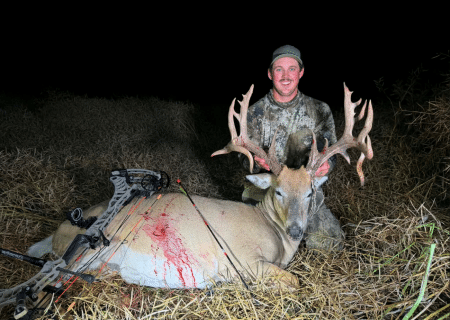
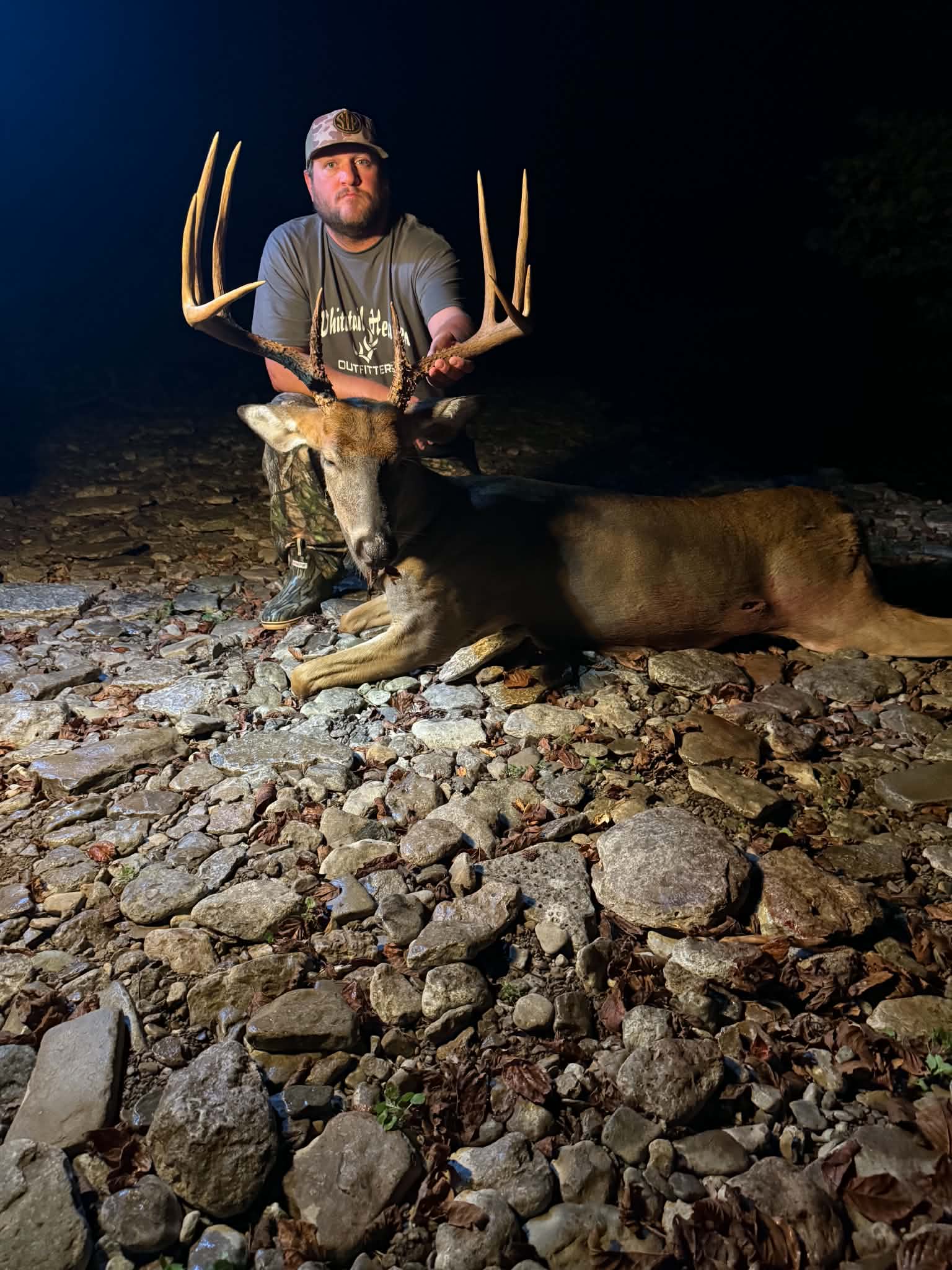
The Kentucky whitetail carried a reported score of 171 3/8 inches, making it Graham’s biggest buck to date.
Passing Good Bucks Was the Hard Part
Holding out for that deer had tested Graham’s patience. He’d let the wide 8-pointer and the drop-tine 10-pointer walk three or four times. His family and others questioned why he kept passing them.
“This deer was a complete rollercoaster of emotions, with highs and lows,” Graham said. “Seeing him so many times without getting a shot was wearing hard on me.”
Still, Graham wanted the bigger buck. He kept returning to the blind and giving the pattern another afternoon to work.
“I held out, and it finally paid off! It was super hard to let the other two go, but in the end, it was well worth it.”
— T.J. Graham
Getting Out Quietly Mattered, Too
Looking back, Graham credited the creek access, his scent-control efforts—including an Ozonics unit—and his binoculars with helping him stay in the hunt.
His Zero Tech binoculars were especially useful when the buck was too far away or appeared after shooting light. They helped him monitor the field and wait until deer had left before slipping out.
“My Zero Tech binoculars were a big game changer, especially the days I saw him out of range, or it was too dark,” Graham said.
Protecting the Next Opportunity
Graham’s routine accounted for both ends of the hunt: use the creek to approach quietly, then watch the field before leaving. With the target buck appearing repeatedly, he worked to avoid disturbing the deer between encounters.
Fourteen afternoons demanded time and patience. For Graham, the result was more than a new personal best.
“It’s by far the most memorable hunt I’ve ever had,” Graham said. “I’ve been blessed to shoot some good deer over my lifetime, but this one is by far at the top of the list and most rewarding.”
More From the Big Buck Series
Graham’s pursuit lasted two weeks. Another Kentucky hunter followed his target for years before finally connecting. Read how a Kentucky bowhunter tagged a 202-inch velvet buck after a five-year pursuit.
Photos courtesy of T.J. Graham.