





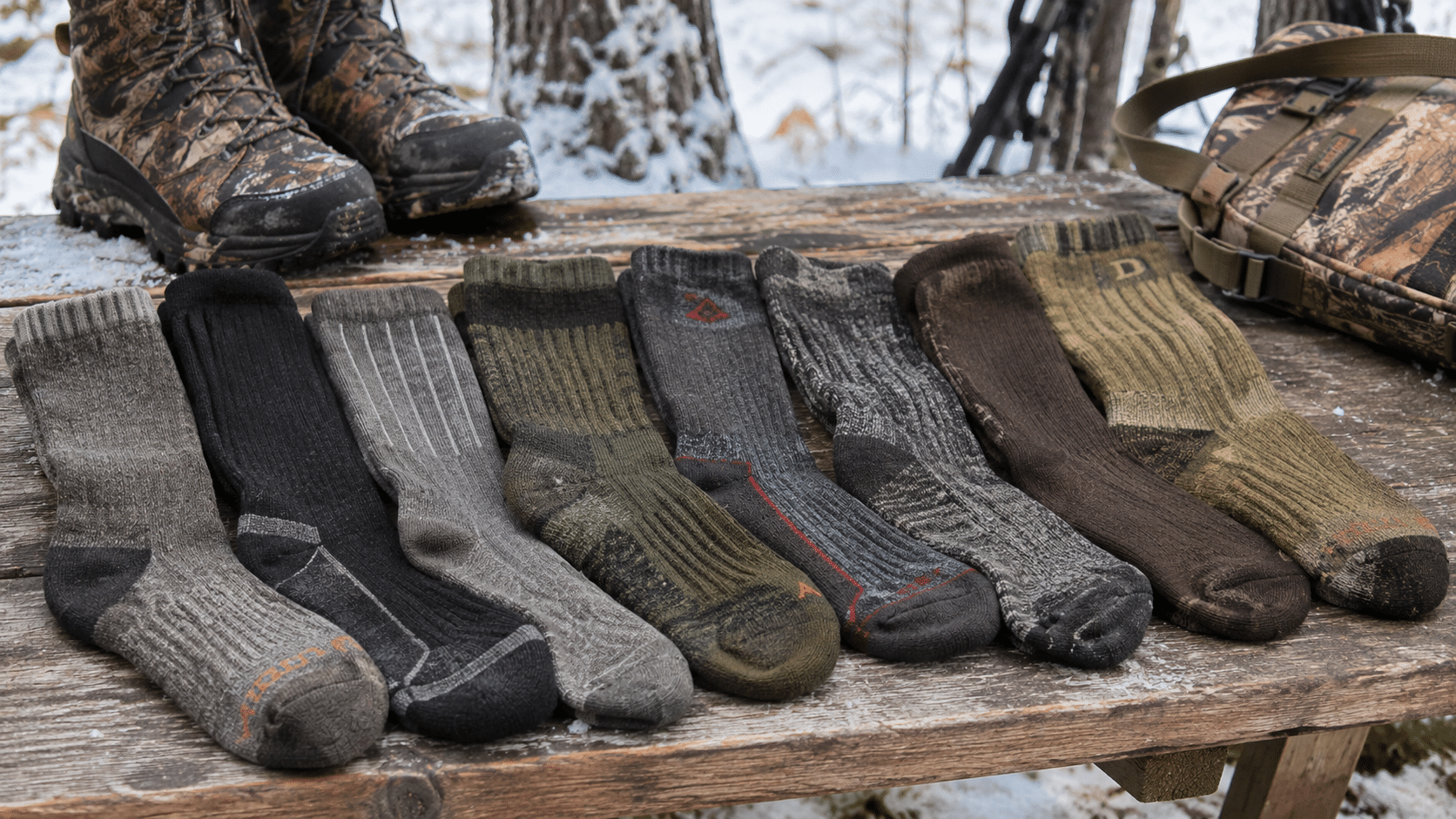
Few things will end a late-season deer hunt faster than cold feet. You can be wearing an expensive insulated jacket, heavyweight bibs, and some of the warmest hunting boots available, but once your toes start going numb, it becomes difficult to concentrate on anything else.
The best hunting socks for cold weather do more than add insulation. They help manage moisture, reduce friction, maintain comfort inside hunting boots, and keep your feet from becoming soaked with perspiration during the walk into the woods.
And here’s something important: the thickest socks aren’t necessarily the warmest.
A heavyweight wool sock compressed inside a tight hunting boot can actually make your feet colder. Proper circulation, moisture management, and boot fit matter every bit as much as insulation.
For this guide, we looked at eight hunting socks designed to address different cold-weather challenges. Some prioritize heavyweight merino wool insulation. Others use rechargeable heating elements, waterproof membranes, or technical synthetic blends.
Our goal was to identify the best options for hunters sitting motionless in a December treestand, tracking deer through snow, hunting in wet conditions, or simply looking for more comfortable socks without spending a fortune.
Not every cold-weather hunting situation calls for the same sock. Our overall selection favors warmth, durability, and versatility, while the other category winners address specific problems such as extreme cold, sweaty feet, and extended stationary hunts.
Jump to a Section
Best Hunting Socks for Cold Weather: Our Picks at a Glance
Editor’s Choice: Best Overall
Darn Tough Hunter Heavyweight
Heavyweight merino wool insulation, full cushioning, excellent durability, and a lifetime guarantee.
Best for Extreme Cold
First Lite Late Season Merino
High merino wool content and heavyweight construction designed for freezing conditions.
Best for Treestands
Smartwool Hunt Classic Maximum Cushion
Maximum cushioning and merino insulation for hunters spending hours sitting motionless.
Editor’s Choice: Best Heated
Fieldsheer Mobile Warming Pro Merino
Rechargeable toe heating and adjustable warmth for hunters who struggle with cold feet.
Best for Walking and Tracking
Kenetrek Canada Midweight
Moisture management and targeted cushioning for hunters covering serious ground.
Best All-Around Comfort
Farm to Feet Ely
Versatile midweight merino construction and full cushioning for varied hunting conditions.
Best Budget
Fox River Wick Dry Maximum
Affordable cushioning and moisture-wicking construction for everyday hunting use.
Best Waterproof
Randy Sun Waterproof Socks
Membrane-based protection for wet vegetation, rain, muddy trails, and marshes.
How We Evaluated the Best Hunting Socks for Cold Weather
The biggest challenge with recommending cold-weather hunting socks is that warmth is not a single specification. A sock that works wonderfully during a three-mile hike can be a poor choice for sitting motionless in a treestand when the temperature drops into the teens.
For this guide, we compared product materials, manufacturer specifications, construction, intended use, and features relevant to different hunting situations.
We did not conduct a controlled, side-by-side field test of all eight products. Rather than inventing temperature ratings or claiming measured performance, we focused on what the products are designed to do and the practical differences hunters should consider.
Our Evaluation Criteria
- Merino wool content and insulating construction
- Sock weight and cushioning
- Moisture-management properties
- Height and compatibility with hunting boots
- Fit, stretch, and pressure management
- Durability and warranty coverage
- Suitability for stationary versus active hunting
- Battery features and runtime for heated socks
- Waterproof construction for wet-weather use
- Value relative to the intended application
Stationary Hunting Versus Active Hunting
For the average late-season whitetail hunter, the biggest concern is staying warm while sitting still.
Once you reach your stand, your feet stop producing the additional heat associated with walking. Insulation becomes increasingly important, particularly when temperatures fall below freezing.
That favors heavyweight merino wool socks with substantial cushioning.
However, someone tracking deer through fresh snow or chasing elk through the mountains has a different problem. Excessive insulation can contribute to sweating, and damp feet become a liability when activity levels change.
For those hunters, a midweight wool-synthetic blend may be preferable.
Moisture Management Matters as Much as Insulation
Hunters often underestimate how much moisture contributes to cold feet.
It doesn’t take a particularly difficult hike to generate perspiration inside insulated hunting boots. If that moisture remains trapped against your skin, your feet may become uncomfortably cold after you stop moving.
Merino wool, polypropylene, and other moisture-managing materials all have advantages over ordinary cotton socks.
Just as importantly, a sock needs enough room inside the boot to maintain its intended insulating loft.
Why We Included Heated and Waterproof Socks
Most conventional hunting socks rely on insulation to retain the heat your body generates.
Heated socks take a different approach by introducing a rechargeable heating system. That makes them particularly interesting for hunters who regularly experience cold toes during stationary hunts.
Waterproof socks address another challenge entirely. Rather than emphasizing maximum insulation, they use a protective membrane to limit water entering from outside.
Neither design is necessary for every hunter, but each can solve a specific problem that traditional wool socks don’t fully address.
Hunting Sock Comparison: Materials and Best Uses
Compare sock construction and recommended hunting applications. Swipe sideways on mobile to view the complete chart.
Remember that thicker socks require additional boot room. The best option is the one that provides sufficient insulation without compressing your foot or restricting circulation.
Best Hunting Socks for Cold Weather: Full Reviews
Editor’s Choice: Best Overall Hunting Socks
Darn Tough Hunter Heavyweight Full Cushion
If I were recommending one pair of socks to the average late-season deer hunter, the Darn Tough Hunter Heavyweight Full Cushion would be my choice.
There are socks designed for extreme cold and others built specifically for long-distance hiking, but the Darn Tough offers an excellent combination of warmth, durability, moisture management, and long-term value.
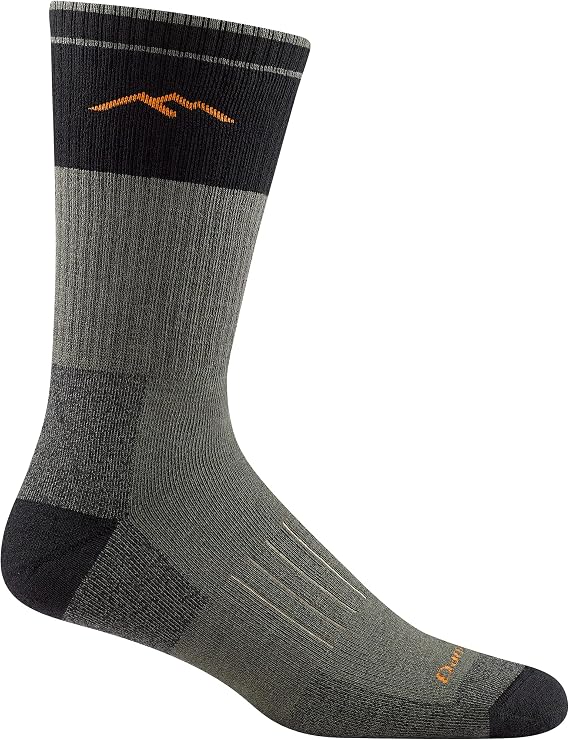
The construction is straightforward. Darn Tough uses a heavyweight merino wool blend with full terry-loop cushioning throughout the sock. That cushioning provides additional insulating material around the foot and lower leg while helping reduce pressure inside hunting boots.
More importantly, the socks aren’t simply thick for the sake of thickness. Their performance-oriented fit is designed to help prevent slipping, bunching, and uncomfortable folds inside your boots.

Heavyweight Merino Wool Insulation
The Hunter Heavyweight uses 75% merino wool, making it one of the more wool-rich socks in our roundup.
Merino wool is especially valuable during late-season hunting because it helps regulate moisture while providing insulation. That matters during the transition from walking to your stand to sitting motionless for several hours.
The full cushioning also creates additional insulation beneath the foot, around the heel, and along the lower leg.
For a hunter spending a cold December morning in a treestand, that combination makes considerable sense.
Fit, Durability, and Warranty
One of the reasons Darn Tough stands out as an overall recommendation is the company’s attention to fit and durability.
The sock incorporates nylon and elastane to help maintain its shape, while the reinforced construction is designed to withstand repeated use.
The company also manufactures its socks in Vermont and backs them with an unconditional lifetime guarantee.
That warranty is especially attractive when you’re purchasing premium socks. A less expensive sock that wears out quickly isn’t necessarily a better value.
The primary consideration is boot fit. Heavyweight socks occupy more room than midweight or lightweight alternatives, so make sure your boots have enough space to accommodate them.
Darn Tough Hunter Heavyweight Specifications
Material: 75% merino wool, 23% nylon, 2% elastane
Weight: Heavyweight
Cushion: Full cushioning
Height: Boot height
Manufacturing: Vermont, USA
Warranty: Unconditional lifetime guarantee
Reasons to Buy
- High merino wool content
- Heavyweight insulation
- Full cushioning throughout
- Secure performance-oriented fit
- Made in the USA
- Unconditional lifetime warranty
Reasons to Consider
- More expensive than basic hunting socks
- Heavyweight construction requires boot room
- May be too warm for mild conditions
- Not waterproof or electronically heated
Best For: Late-season deer hunters who want one dependable, heavyweight merino wool sock for cold mornings, extended sits, and regular use throughout hunting season.
Hunter’s Verdict
The Darn Tough Hunter Heavyweight offers the features I’d prioritize in an everyday cold-weather hunting sock.
It has substantial merino wool insulation, full cushioning, a secure fit, and a warranty that adds meaningful long-term value.
It’s not the most specialized option in this roundup. The First Lite is more specifically oriented toward extreme cold, and Fieldsheer provides active heating.
But for most hunters, the Darn Tough offers an especially practical balance.
Buying Verdict: My overall recommendation for hunters who want a premium cold-weather sock with substantial insulation, excellent construction, and outstanding warranty protection.
Best Hunting Socks for Extreme Cold
First Lite Late Season Merino Wool OTC Socks
There comes a point during winter when staying warm becomes a bigger challenge than finding deer.
When temperatures drop into the teens or single digits, sitting motionless for several hours can be downright uncomfortable, even with good insulated boots.
First Lite’s Late Season Merino Wool OTC Socks are built specifically for that type of hunting.
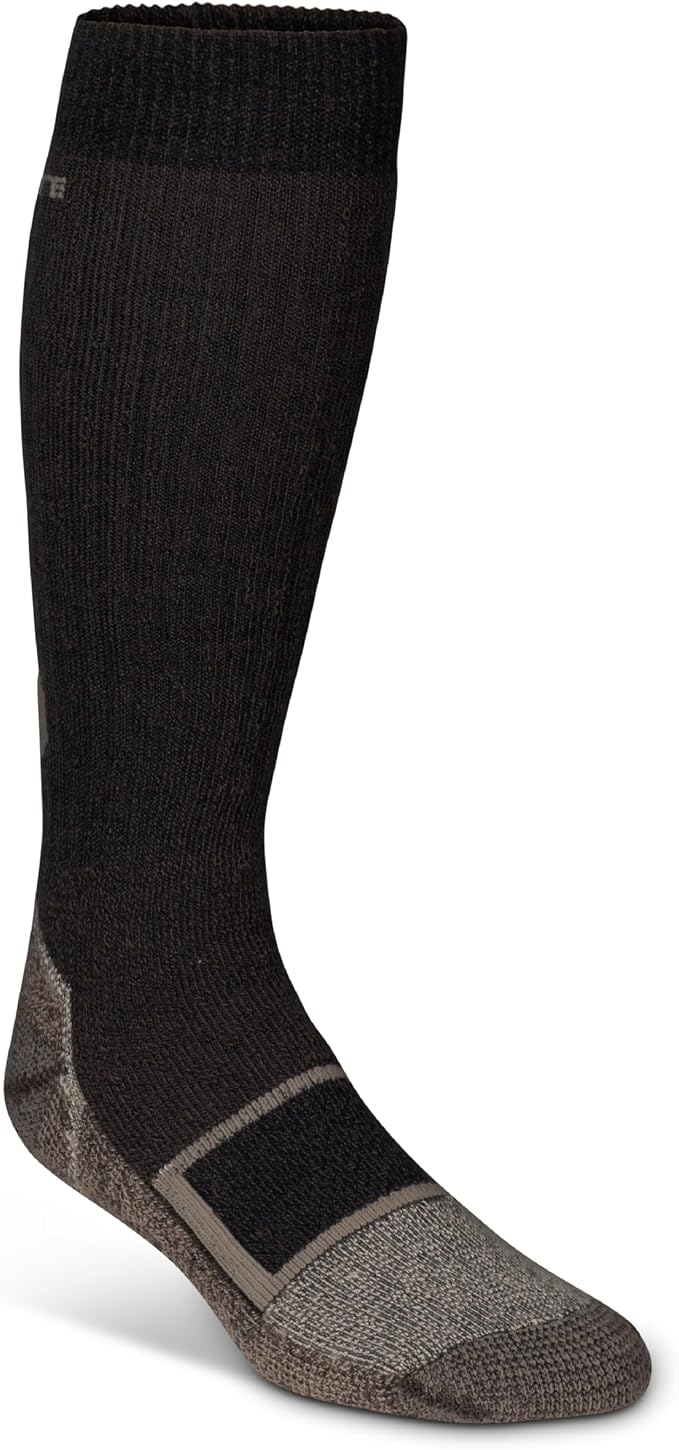
The company uses a heavyweight construction with 79% merino wool, putting these among the highest wool-content options in this roundup.

Built for Frigid Temperatures
First Lite identifies these socks as a late-season option intended for temperatures below 20 degrees Fahrenheit.
That doesn’t mean they guarantee warm feet at any specific temperature. Your boots, circulation, activity level, and exposure all influence comfort.
But the construction tells us what First Lite intended: substantial insulation for hunters spending time in very cold conditions.
Full cushioning adds insulating material throughout the sock, while the high wool content provides warmth and moisture-management benefits.
The over-the-calf height is another advantage with tall rubber boots and insulated leather hunting boots.
Why Fit Still Matters
First Lite incorporates a Lycra fit panel designed to keep the sock secure across the foot.
That’s a valuable feature because bunching and wrinkles become particularly uncomfortable when you’re wearing insulated boots for hours.
However, heavyweight socks need sufficient room.
If your boots are already tight with conventional socks, adding this much material may reduce circulation rather than improve warmth.
For hunters with boots sized to accommodate heavyweight socks, the Late Season Merino is a compelling cold-weather option.
First Lite Late Season Specifications
Material: 79% merino wool, 20% nylon, 1% Lycra
Weight: Heavyweight
Height: Over the calf
Cushion: Full
Manufacturer Temperature Category: Below 20°F
Manufacturing: USA
Reasons to Buy
- 79% merino wool content
- Heavyweight insulation
- Full cushioning
- Over-the-calf coverage
- Designed for cold late-season hunts
Reasons to Consider
- Bulky in tightly fitted boots
- Not ideal for warm early-season hunts
- May cause excessive sweating during strenuous activity
- Premium price compared with basic wool socks
Best For: Northern whitetail hunters, late-season treestand hunting, and anyone spending extended periods in freezing temperatures.
Hunter’s Verdict
For hunters primarily concerned with staying warm during long December hunts, First Lite’s Late Season Merino deserves serious consideration.
The high wool percentage, substantial cushioning, and extended coverage all support its intended purpose.
Just make sure the rest of your footwear system can accommodate the added bulk.
Buying Verdict: An excellent insulation-focused choice for hunters facing bitter cold who have properly fitted boots with room for heavyweight merino socks.
Best Hunting Socks for Long Treestand Sits
Smartwool Hunt Classic Maximum Cushion OTC Socks
The biggest difference between walking through the woods and sitting in a treestand is how much heat your body produces.
When you’re hiking, climbing, or tracking deer, your feet benefit from the warmth generated by movement.
Once you settle into a stand and stop moving, that advantage disappears.
Smartwool’s Hunt Classic Maximum Cushion socks are designed with that reality in mind.
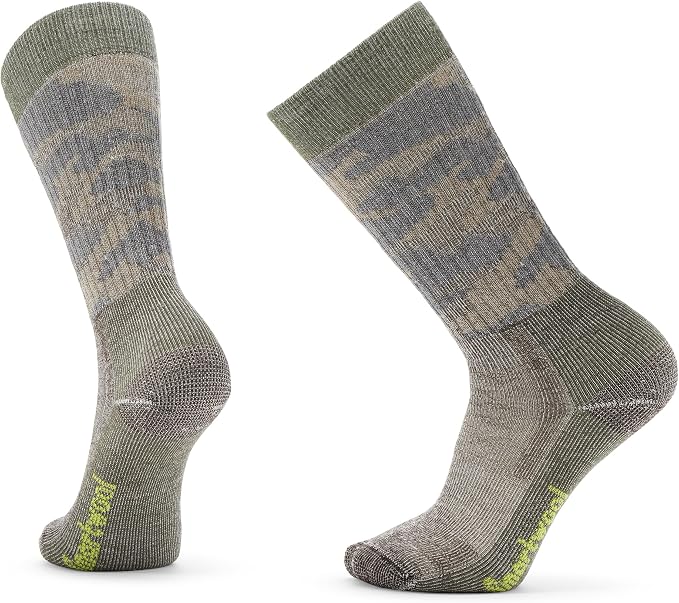
Their maximum-cushion construction provides substantial padding and insulating material, making them particularly well suited to hunters who spend hours sitting in one location.

Maximum Cushioning for Stationary Hunting
Smartwool uses a merino wool blend to provide insulation and moisture management.
The defining feature, however, is the cushioning.
Maximum-cushion construction adds padding around the foot and lower leg, providing additional comfort while increasing the amount of insulating material inside the boot.
That’s useful for hunters who sit for several hours with relatively little movement.
These socks also feature an over-the-calf design, providing coverage above the height of many conventional boot socks.
The Importance of Proper Boot Fit
There is one consideration worth emphasizing before buying these socks.
Maximum cushioning takes up space.
If your boots already fit snugly, adding a heavily cushioned sock can make them uncomfortably tight.
That pressure can restrict circulation and potentially make your feet colder.
The right combination is a sock with substantial cushioning inside a boot that still provides enough room to move your toes comfortably.
For hunters whose footwear accommodates the added material, Smartwool’s Hunt Classic is a strong stationary-hunting option.
Smartwool Hunt Classic Specifications
Material: Merino wool blend
Cushion: Maximum
Height: Over the calf
Construction: Hunting-specific cushioned design
Heating: Passive insulation, no batteries
Reasons to Buy
- Maximum-cushion construction
- Merino wool insulation
- Over-the-calf coverage
- Designed for hunting
- No batteries or charging required
Reasons to Consider
- Requires additional room in boots
- May be too bulky for active hunts
- Not waterproof
- Availability can vary by size
Best For: Hunters who spend long periods sitting in treestands, ground blinds, or other stationary positions during cold weather.
Hunter’s Verdict
Smartwool’s maximum-cushion construction addresses one of the biggest challenges of late-season deer hunting: keeping your feet comfortable while sitting still.
These socks make the most sense for hunters wearing properly fitted insulated boots who prioritize warmth over reducing bulk.
Buying Verdict: A strong option for stationary hunters who want maximum cushioning, merino wool insulation, and over-the-calf coverage without using heated socks.
Editor’s Choice: Best Heated Hunting Socks
Fieldsheer Mobile Warming Pro Merino Heated Socks
There are times when even excellent wool socks aren’t enough to keep your feet comfortable.
Some hunters naturally struggle with cold toes, while others spend so much time sitting motionless in freezing temperatures that conventional insulation eventually becomes insufficient.
That’s where heated socks can make a meaningful difference.
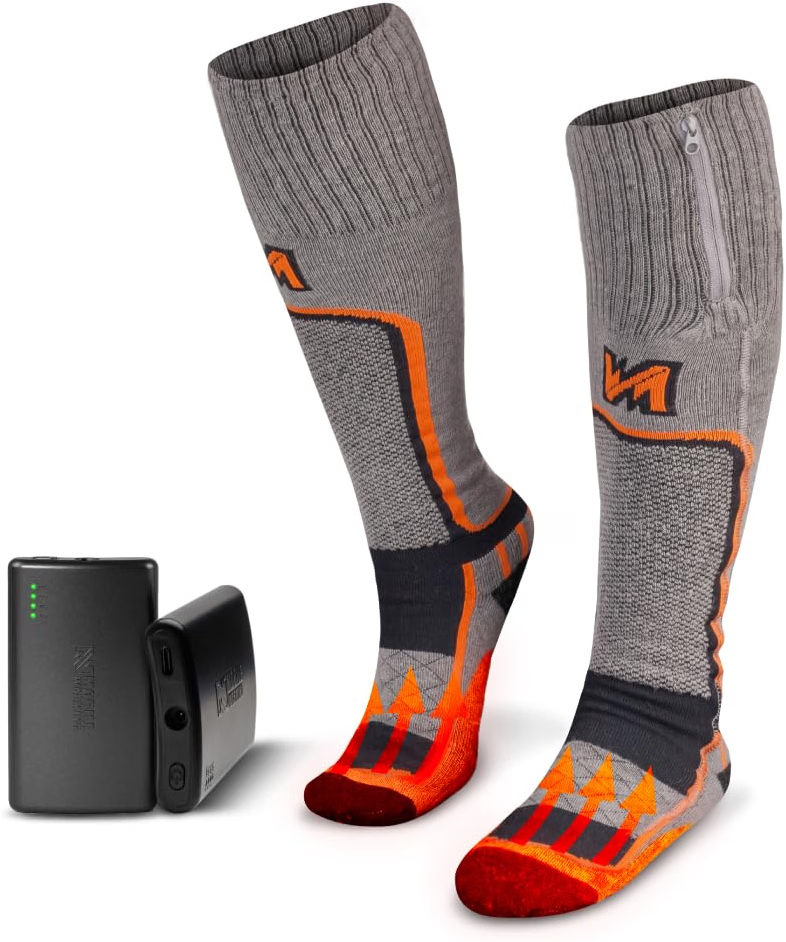
The Fieldsheer Mobile Warming Pro Merino Heated Socks combine traditional wool insulation with rechargeable heating technology, providing an additional source of warmth when your body isn’t generating enough heat on its own.
For hunters who consistently leave the woods because their feet get cold, this is a product category worth serious consideration.

Heating Technology and Toe Coverage
The biggest advantage of the Fieldsheer system is its heating placement.
Heating elements are positioned above and below the toes, providing warmth around the area where many hunters experience the greatest discomfort.
This approach is particularly useful during long stationary hunts, when your feet are no longer benefiting from the additional circulation and heat associated with walking.
The socks incorporate a merino wool blend, so they provide conventional insulation even when the heating system is turned off.
That gives hunters two methods of managing temperature rather than relying exclusively on battery power.
Battery Runtime and Adjustable Heat
Fieldsheer uses rechargeable 3.7-volt lithium-ion batteries with a 3600mAh capacity.
The heating system offers four temperature settings, allowing users to adjust output according to conditions.
Fieldsheer advertises more than 13 hours of runtime on its lowest setting. Higher settings draw more power and reduce operating time.
That’s important for hunters planning an all-day sit.
Rather than using maximum heat continuously, starting with a lower setting and increasing warmth only when necessary can help conserve battery life.
Bluetooth functionality also allows compatible smartphone control, making temperature adjustments more convenient when you’re already dressed in multiple layers.
Comfort and Practical Considerations
Heated socks have advantages, but they also introduce additional components to your footwear.
The batteries need to be charged, the controls need to be accessible, and the battery placement should not interfere with boot fit.
It’s also important to use heated clothing according to the manufacturer’s instructions, particularly regarding battery handling, washing, and temperature settings.
For hunters who already stay warm in conventional wool socks, this added complexity may be unnecessary.
But if cold toes are consistently the reason you climb out of your stand early, active heating can be a valuable upgrade.
Fieldsheer Pro Merino Specifications
Material: Merino wool blend
Heating Zones: Above and below toes
Heating Levels: Four
Battery: 3.7V, 3600mAh rechargeable lithium-ion
Advertised Runtime: More than 13 hours on low
Control: Bluetooth-compatible
Included: Rechargeable batteries and charging accessories
Reasons to Buy
- Active heating around the toes
- Four adjustable heat settings
- Rechargeable battery system
- Merino wool construction
- Bluetooth control
- Useful for extended stationary hunts
Reasons to Consider
- Higher purchase price
- Requires charging
- Battery runtime declines at higher settings
- Battery placement requires attention to fit
- More components than conventional socks
Best For: Hunters who regularly experience cold toes, spend long hours in freezing treestands, or want adjustable supplemental warmth inside their boots.
Hunter’s Verdict
For hunters whose feet get cold regardless of how much conventional insulation they wear, the Fieldsheer Pro Merino offers a different approach.
Its rechargeable heating system allows hunters to add warmth when needed, while the merino wool construction provides a useful insulating foundation.
The higher price is the primary drawback, but for someone who regularly cuts a hunt short because of cold feet, the investment may be worthwhile.
Buying Verdict: My top heated sock recommendation for hunters who need active, adjustable warmth rather than relying on conventional insulation alone.
Best Hunting Socks for Walking and Tracking
Kenetrek Canada Midweight Over-the-Calf Socks
The requirements for staying warm while tracking deer through snow are different from those of a hunter sitting in one place all morning.
When you’re walking, your body produces additional heat. You’re also much more likely to perspire, especially when wearing insulated boots.
Too much sock insulation can become a disadvantage if it causes your feet to sweat excessively.
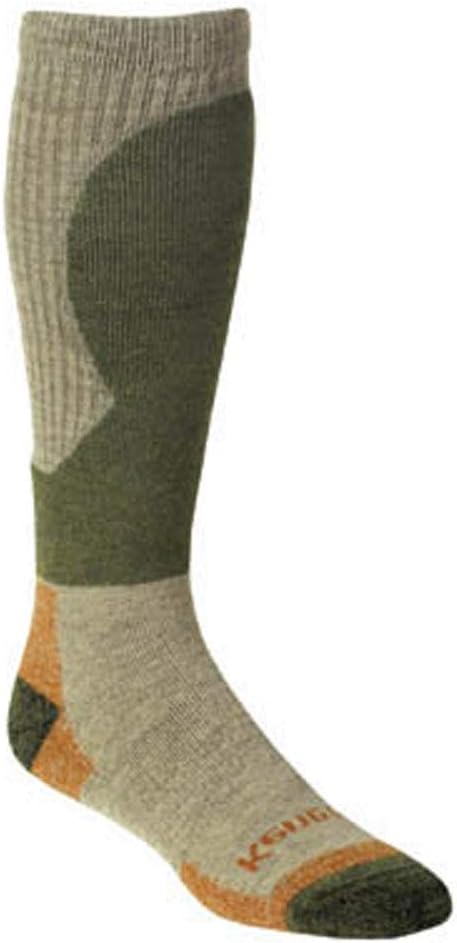
Kenetrek’s Canada Midweight socks are designed to balance warmth with moisture management and comfort during movement.

Merino Wool and Polypropylene Construction
Kenetrek uses a blend containing equal amounts of merino wool and polypropylene.
Each material serves a purpose.
Merino wool provides insulation and temperature regulation, while polypropylene helps transport moisture away from the skin.
The result is a sock designed to provide comfort without the excessive bulk of a traditional heavyweight winter sock.
For hunters who spend the day moving, that’s often a better approach than simply adding more insulation.
Comfort with Tall Hunting Boots
The Canada Midweight also features cushioning and reinforcement around areas that experience pressure during walking.
These include the heel, toe, and shin.
That design is particularly relevant when wearing stiff, high-cut hunting boots.
During long hikes, friction and pressure can become just as uncomfortable as cold feet.
The over-the-calf height also helps maintain coverage inside taller boots.
For tracking whitetails, hunting western big game, or spending considerable time on your feet, Kenetrek’s balanced design is a strong option.
Kenetrek Canada Midweight Specifications
Material: 33% merino wool
Polypropylene: 33%
Nylon: 26%
Elastic: 5%
Lycra: 3%
Weight: Midweight
Height: Over the calf
Manufacturing: USA
Reasons to Buy
- Balanced moisture-management design
- Less bulky than heavyweight socks
- Targeted cushioning
- Good fit with tall hunting boots
- Suitable for active hunting
Reasons to Consider
- Less insulation than heavyweight options
- Not primarily intended for extreme stationary cold
- Lower wool percentage than some alternatives
Best For: Hunters who spend substantial time walking, tracking deer, covering mountain terrain, or moving between hunting locations.
Hunter’s Verdict
The Kenetrek Canada Midweight makes sense for hunters who understand that moisture can be as much of a problem as cold.
Its combination of wool, polypropylene, and targeted cushioning is particularly well suited to active hunting.
It wouldn’t be my first choice for an all-day sit in single-digit temperatures, but for hunters covering miles, it deserves a close look.
Buying Verdict: A practical midweight sock for mobile hunters who prioritize moisture management, comfort, and a secure fit inside tall hunting boots.
Best All-Around Hunting Socks for Comfort
Farm to Feet Ely Full Cushion Hunting Socks
Not every hunting trip requires a specialty sock designed for extreme cold or long-distance hiking.
Sometimes you need a dependable pair that works well across a range of temperatures and activity levels.
That’s where the Farm to Feet Ely fits into this roundup.
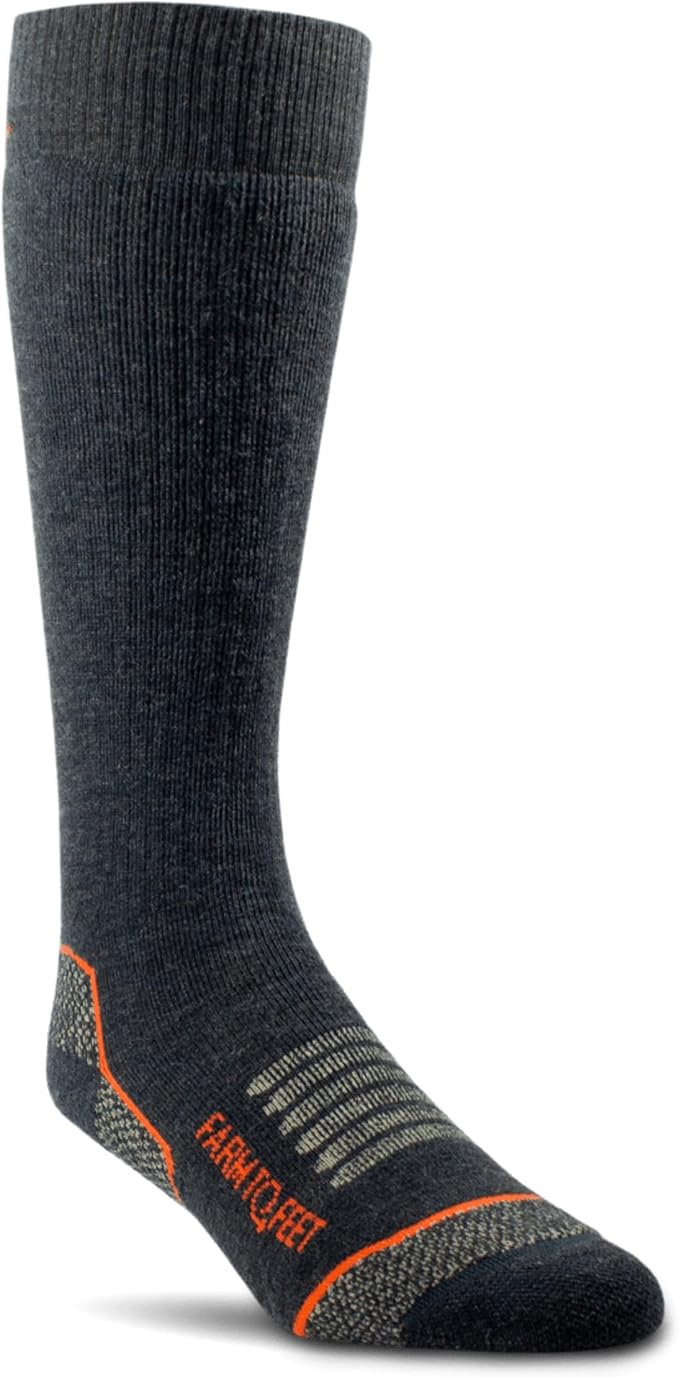
Made with American-grown merino wool, these socks combine midweight construction with full cushioning to create a versatile hunting option.

A Versatile Balance of Warmth and Comfort
The Ely provides full cushioning without relying on the heavier construction found in some dedicated winter socks.
That makes it useful for hunters who alternate between walking and sitting throughout the day.
The merino wool blend provides insulation and helps manage moisture, while the midweight design reduces the chance of excessive bulk inside boots.
For early and midseason hunting, that combination may be more practical than a dedicated extreme-cold sock.
It can also work well during moderately cold late-season conditions, depending on your boots and activity level.
American Wool and Construction
Farm to Feet emphasizes domestic sourcing and manufacturing.
The company uses American-grown merino wool and manufactures its socks in the United States.
That commitment may appeal to hunters who prioritize American-made equipment.
The Ely’s mid-calf height is suitable for many traditional hunting boots, although hunters using tall rubber boots may prefer a taller sock.
Farm to Feet Ely Specifications
Material: American merino wool blend
Weight: Midweight
Cushion: Full
Height: Mid-calf
Application: Hunting and outdoor activities
Manufacturing: USA
Reasons to Buy
- Versatile midweight construction
- Full cushioning
- Merino wool insulation
- American-sourced wool
- Made in the USA
Reasons to Consider
- Less insulation than heavyweight socks
- Mid-calf height may be short for some boots
- Not intended primarily for extreme cold
Best For: Hunters who want one comfortable, versatile merino wool sock for a range of temperatures and hunting activities.
Hunter’s Verdict
The Farm to Feet Ely strikes a useful balance between insulation, cushioning, and versatility.
Hunters who spend time in the woods throughout the fall may appreciate having one dependable sock that isn’t overly specialized.
For the coldest stationary hunts, a heavier option would be worth considering. But for general use, the Ely makes a strong case.
Buying Verdict: A comfortable, American-made merino wool option for hunters who want versatility rather than maximum insulation.
Best Budget Hunting Socks
Fox River Wick Dry Maximum Socks
Good hunting socks don’t necessarily have to cost as much as a box of ammunition.
While premium merino wool socks offer meaningful advantages, there are affordable synthetic alternatives that focus on moisture management and comfort.
Fox River’s Wick Dry Maximum is one of those options.
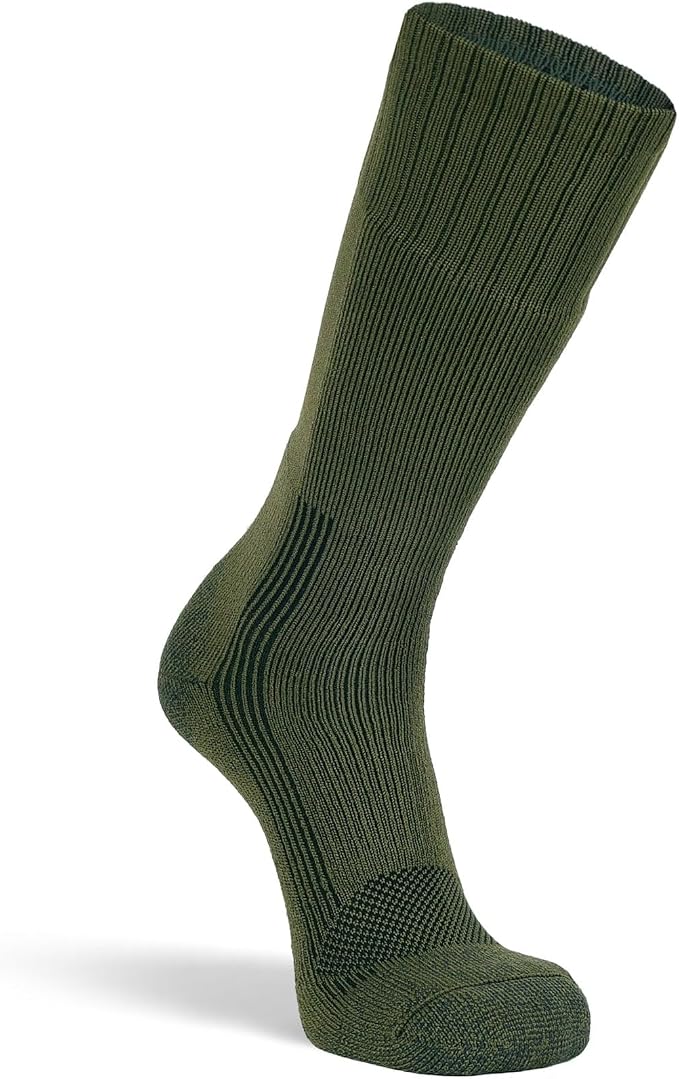
The construction emphasizes moving moisture away from the skin, an important feature for hunters who generate perspiration during the walk to their stand.

Moisture Management Without Premium Pricing
The Wick Dry family uses synthetic fibers intended to help transport moisture away from the skin.
That can be useful during cold-weather hunting because damp feet often become uncomfortable after you stop moving.
For hunters walking moderate distances before settling into a stand, moisture management can be just as important as additional insulation.
The socks also incorporate cushioning designed to improve comfort inside boots.
Although this isn’t our recommendation for the coldest stationary hunting conditions, it provides a useful option for hunters who need comfortable boot socks at a more accessible price.
Who Should Choose a Synthetic Sock?
Synthetic socks can work particularly well for active hunters.
They are also useful for people who prefer a lighter sock or whose boots don’t have enough room for heavyweight wool.
The key is matching the sock to the weather.
For a long sit in extremely cold conditions, heavyweight merino or a heated option would generally be preferable.
For moderately cold conditions involving substantial walking, a moisture-wicking synthetic sock can be perfectly reasonable.
Fox River Wick Dry Maximum Specifications
Material: Moisture-wicking synthetic blend
Technology: Wick Dry moisture management
Cushioning: Cushioned boot-sock construction
Insulation Type: Passive
Application: Everyday boot wear and active outdoor use
Reasons to Buy
- Affordable price
- Moisture-wicking construction
- Cushioned boot comfort
- Useful for active hunting
- Good option for purchasing multiple pairs
Reasons to Consider
- Less insulation than heavyweight merino socks
- Not intended specifically for extreme cold
- No active heating
- Specifications vary across Wick Dry models
Best For: Budget-conscious hunters, active hunts in moderately cold weather, and anyone looking for comfortable moisture-wicking socks.
Hunter’s Verdict
Fox River offers a practical alternative for hunters who don’t want to invest heavily in premium wool socks.
It isn’t the warmest option in this guide, but moisture management and comfort still have plenty of value.
For hunters buying several pairs or looking for an everyday boot sock, it deserves consideration.
Buying Verdict: An affordable, moisture-focused sock for hunters who want everyday comfort without paying premium merino wool prices.
Best Waterproof Hunting Socks
Randy Sun Waterproof Socks
Not every cold-weather hunt takes place on frozen ground.
In many parts of the country, December brings wet leaves, muddy trails, standing water, and freezing rain.
Even if temperatures aren’t particularly low, wet feet can quickly make a hunt uncomfortable.
Randy Sun’s waterproof socks are designed to address that problem.
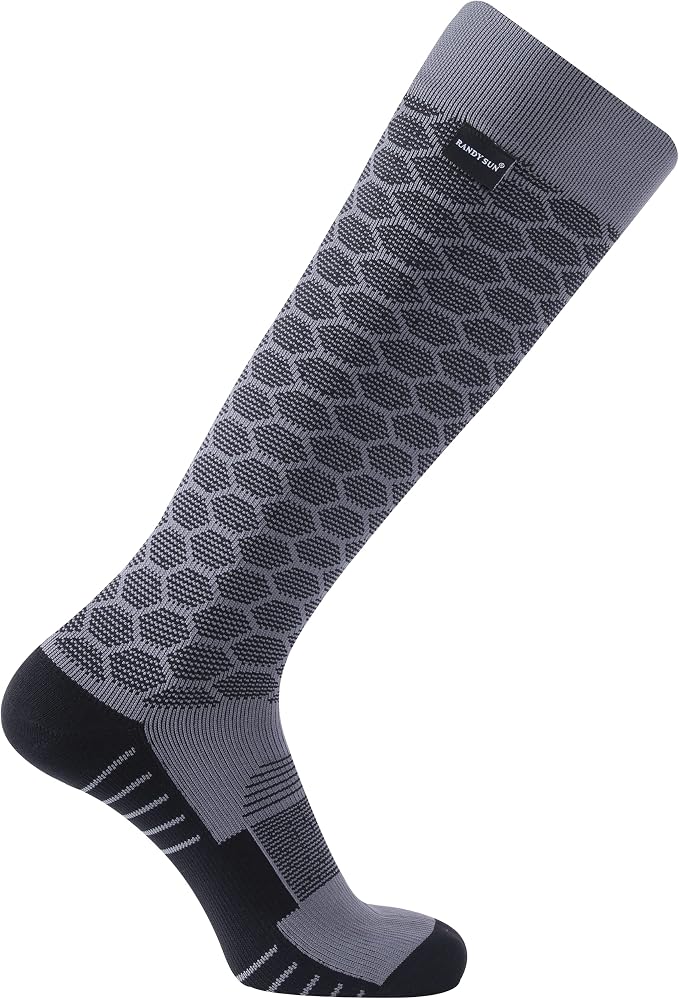
Rather than relying exclusively on wool insulation, they use a multilayer construction incorporating a waterproof membrane.

Waterproof Membrane Construction
The central advantage of these socks is the membrane.
Designed to block outside water while allowing some moisture vapor to escape, the construction provides additional protection when walking through wet vegetation or hunting in muddy conditions.
That can be helpful when your boots become saturated or when moisture finds its way through footwear that is no longer completely waterproof.
However, waterproof socks aren’t a complete replacement for waterproof boots.
Water can still enter from above the cuff, and a waterproof membrane generally offers less ventilation than a conventional knit sock.
Warmth Versus Waterproofing
There’s an important distinction between keeping water out and providing insulation.
Waterproof socks are particularly useful when external moisture is the primary concern.
For extreme cold, a heavily insulated wool sock may be more appropriate, especially if the hunter is wearing dependable waterproof footwear.
In some situations, waterproof socks can also create additional perspiration because of reduced breathability.
That makes them a specialty option rather than something every hunter necessarily needs.
For waterfowl hunters, hunters crossing wet terrain, and anyone dealing with persistent rain, however, the protection may be worthwhile.
Randy Sun Waterproof Sock Specifications
Construction: Multilayer waterproof design
Water Protection: Waterproof membrane
Breathability: Moisture-vapor-permeable construction
Primary Application: Wet outdoor conditions
Available Configurations: Multiple heights and designs
Reasons to Buy
- Waterproof membrane protection
- Useful in muddy or wet conditions
- Additional defense against outside moisture
- Versatile across outdoor activities
- Potential backup protection for damp footwear
Reasons to Consider
- Less breathable than conventional socks
- Water can enter above the cuff
- Not specifically designed for maximum insulation
- May feel warmer during strenuous activity
Best For: Hunters dealing with wet grass, rain, marshes, muddy trails, and other conditions where keeping outside moisture away from the foot is the primary concern.
Hunter’s Verdict
Randy Sun waterproof socks address a different problem from the heavyweight wool models in this guide.
They prioritize keeping external moisture out rather than providing the most insulation possible.
For hunters regularly dealing with wet terrain, that’s a useful distinction.
Buying Verdict: A worthwhile specialty option for wet-weather hunters who need additional protection against outside moisture.
Cold Weather Hunting Sock Buyer’s Guide
Buying warm hunting socks isn’t as simple as choosing the thickest pair available.
Your hunting style, footwear, circulation, perspiration, and the temperatures you encounter all affect which socks will be most comfortable.
Here are the factors to consider before making a purchase.
Merino Wool Versus Synthetic Hunting Socks
Merino wool is one of the most useful materials for cold-weather hunting apparel.
Its fibers help regulate temperature, manage moisture, and resist odors, which makes it particularly attractive for hunters who wear the same clothing for long periods.
Unlike cotton, merino wool can retain useful insulating properties when damp.
Synthetic materials such as polypropylene and polyester offer their own advantages, especially when it comes to moisture transport and drying.
For stationary winter hunting, a quality heavyweight merino wool blend is generally an excellent choice.
For active hunting, a midweight wool-synthetic blend may provide better comfort.
The important thing isn’t choosing wool or synthetic simply because one sounds better. It’s understanding which construction matches the way you hunt.
Sock Thickness and Boot Fit
This may be the single most important factor in keeping your feet warm.
Thick socks need space.
When you force heavyweight socks into boots that are already tight, you compress their insulating material and may restrict circulation.
Both conditions can make cold feet more likely.
Your toes should have enough room to move comfortably, and your socks should lie flat without bunching.
Before purchasing extremely thick socks, make sure your boots can accommodate them. A properly fitted midweight sock may keep you warmer than a heavyweight sock packed into a tight boot.
Moisture Management During the Walk In
One of the biggest mistakes hunters make is sweating excessively before they even reach their stand.
A brisk walk through deep snow or uneven terrain can generate considerable body heat, especially when you’re wearing insulated boots and heavyweight clothing.
Once you stop moving, that moisture can contribute to cold feet.
Choosing moisture-wicking socks helps, but so does regulating your pace and avoiding unnecessary overheating.
For longer walks in very cold conditions, carrying a dry replacement pair of socks is worth considering. Starting your stationary hunt with dry feet can make a meaningful difference.
Heavyweight Versus Midweight Hunting Socks
Heavyweight socks generally provide more insulating material and are particularly useful for stationary cold-weather activities.
Midweight socks usually offer a better balance of warmth, breathability, and reduced bulk.
For long treestand sits in freezing temperatures, heavyweight socks are often the more practical choice.
For tracking deer, mountain hunting, and other activities involving substantial movement, a midweight option may be preferable.
Matching sock weight to the hunt is more useful than automatically wearing the same heavyweight pair every time you head into the woods.
Are Heated Hunting Socks Worth It?
For some hunters, absolutely.
Traditional socks retain the heat produced by your body. Heated socks actively generate additional warmth.
That can be especially valuable when you’re sitting motionless for several hours in freezing conditions.
The biggest considerations are price, battery runtime, charging requirements, and how the batteries fit with your boots and clothing.
Heated socks also aren’t a replacement for properly insulated footwear.
If your feet regularly become cold enough to force you out of the woods, heated socks may be worth the investment. If you’re already comfortable in quality wool socks, the extra technology may be unnecessary.
Waterproof Socks Versus Waterproof Boots
Waterproof socks and waterproof hunting boots serve related but different purposes.
A quality waterproof boot is normally your first line of protection against external moisture.
Waterproof socks add another protective layer, which can be useful when footwear becomes saturated or water reaches the inside of a boot.
However, waterproof socks generally provide less breathability than traditional knit socks.
For most cold-weather hunters, properly fitted waterproof boots and insulating socks should come first. Waterproof socks are especially useful for situations where moisture intrusion is a recurring problem.
Should You Wear Two Pairs of Socks?
Sometimes, but not automatically.
A thin moisture-wicking liner underneath a wool sock can work well when the boot provides enough room.
However, layering two thick pairs often creates more problems than benefits.
The added bulk can restrict circulation and compress insulation.
For many hunters, one well-fitted heavyweight merino wool sock will be more comfortable than two pairs squeezed inside a tight hunting boot.
How to Keep Your Feet Warm in a Treestand
Choosing good socks is only one part of staying warm.
Start with completely dry boots and socks. Avoid overheating during the walk in, and make sure your boots don’t restrict circulation.
For extremely cold stationary hunts, insulated boot covers can provide another layer of protection.
Some hunters also benefit from approved foot warmers or heated socks.
The goal is to maintain warmth without trapping excessive moisture or restricting circulation. Cold-weather footwear works best as a complete system rather than a collection of individual products.
Keeping your feet warm is only one part of staying comfortable during late-season deer hunting. Your base layers, insulated boots, outerwear, and accessories all need to work together. For more recommendations, check out our guide to the best cold weather hunting gear to build a complete system for freezing temperatures.
Which Hunting Socks Should You Buy?
Different hunting situations call for different priorities. Here’s how we’d match these socks to common cold-weather conditions.
Best Socks for Late-Season Deer Hunting
Darn Tough Hunter Heavyweight. For the average deer hunter who walks to a stand and then sits for several hours, these offer an excellent combination of insulation, moisture management, durability, and value.
Best Hunting Socks for Extreme Cold
First Lite Late Season Merino. Heavyweight construction, 79% merino wool, and over-the-calf coverage make these especially well suited to freezing winter conditions.
Best Socks for Sitting in a Treestand All Day
Smartwool Hunt Classic Maximum Cushion. The substantial cushioning and merino wool construction make these a strong option for stationary hunting when boot fit allows the extra bulk.
Best Socks for Hunters with Constantly Cold Feet
Fieldsheer Mobile Warming Pro Merino. Rechargeable heating elements provide adjustable warmth around the toes, helping address cold feet that conventional insulation alone may not solve.
Best Socks for Tracking Deer in Snow
Kenetrek Canada Midweight. Its wool-synthetic blend and targeted cushioning are particularly well suited to hunters who spend substantial time walking.
Best Hunting Socks for Multiple Seasons
Farm to Feet Ely. Midweight construction and full cushioning provide a versatile option for hunters facing changing conditions throughout the fall.
Best Affordable Hunting Socks
Fox River Wick Dry Maximum. A practical choice for hunters prioritizing moisture management and comfort without investing in premium heavyweight wool socks.
Best Hunting Socks for Wet Conditions
Randy Sun Waterproof Socks. Their membrane construction offers additional protection when dealing with rain, muddy terrain, and wet vegetation.
Frequently Asked Questions About Cold Weather Hunting Socks
Cold feet are one of the most common complaints during late-season deer hunting. Here are answers to questions hunters frequently have about choosing and wearing winter socks.
What are the warmest socks for deer hunting?
Heavyweight merino wool socks with substantial cushioning are among the best choices for cold-weather deer hunting. First Lite Late Season Merino, Darn Tough Hunter Heavyweight, and Smartwool Hunt Classic Maximum Cushion are strong options. The warmest combination also depends on your boots, circulation, and activity level.
Are merino wool socks better for hunting?
Merino wool is particularly useful for hunting because it provides insulation, manages moisture, and naturally resists odors. However, synthetic socks can also perform well, especially for active hunters who prioritize quick drying and moisture transport.
What socks should I wear hunting in 10-degree weather?
For stationary hunting around 10°F, consider heavyweight merino wool socks paired with properly fitted insulated hunting boots. Heated socks or insulated boot covers may provide additional comfort. Avoid tight footwear, and remember that a sock alone cannot guarantee warmth at a specific temperature.
Why do my feet get cold even with insulated hunting boots?
Common causes include sweaty socks, inadequate boot fit, restricted circulation, compressed insulation, and prolonged inactivity. If your boots are too tight, adding thicker socks can make the problem worse. Try dry moisture-wicking socks, ensure sufficient toe room, and match insulation to your activity level.
Are heated socks better than wool socks?
Heated socks provide active warmth, while traditional wool socks retain body heat. Heated designs can be especially useful for hunters sitting motionless in very cold conditions. Quality wool socks remain simpler, less expensive, and appropriate for many hunting situations.
Are thick socks always warmer?
No. Thick socks need enough room inside the boot to maintain insulating loft and allow healthy circulation. If they make your boots too tight, they may actually contribute to colder feet. A properly fitted midweight sock can be warmer than an excessively thick sock compressed inside tight footwear.
Should you wear two pairs of socks while hunting?
A thin liner beneath a wool sock can work well if your boots have sufficient room. However, layering two thick pairs may restrict circulation and compress insulation. Many hunters are better served by one quality merino wool sock that fits correctly.
Do waterproof hunting socks keep your feet warmer?
Waterproof socks can help keep your feet warmer indirectly by preventing outside moisture from reaching the skin. However, waterproofing is not the same as insulation. In very cold conditions, properly fitted insulated boots and appropriate wool socks are usually the foundation of a warm footwear system.
What is the best sock material for winter hunting?
Merino wool blends are among the most versatile choices because they provide insulation and manage moisture. Polypropylene and polyester blends are also useful, particularly for active hunting. Cotton is generally a poor choice for cold, wet conditions because it retains moisture and dries slowly.
How do I keep my feet from sweating on the walk to my treestand?
Use moisture-wicking socks, avoid unnecessary insulation during the walk, and regulate your pace to reduce excessive sweating. Consider carrying a dry pair of socks for especially long or strenuous walks. Damp socks can make stationary hunting considerably colder.
How often should hunting socks be replaced?
Replace socks when they develop holes, lose elasticity, bunch inside boots, or no longer provide adequate cushioning. High-quality socks can last multiple seasons when properly maintained. Follow the manufacturer’s washing and drying instructions, particularly for merino wool and heated products.
What is the best way to dry hunting socks between hunts?
Remove damp socks from boots as soon as possible and allow them to dry completely. Follow the manufacturer’s care instructions for washing and machine drying. Heated socks require additional care, including removal of electronic components when directed. Keeping boots dry is equally important.
Final Thoughts: Don’t Let Cold Feet End Your Hunt
There are few things more frustrating than leaving a productive stand because your feet have become too cold to tolerate.
And while insulated boots receive most of the attention, the socks you wear inside those boots are an important part of staying comfortable.
A quality sock should provide enough insulation for the conditions, manage moisture, maintain a comfortable fit, and work with your footwear rather than against it.
For most late-season hunters, our overall recommendation is the Darn Tough Hunter Heavyweight Full Cushion. Its combination of merino wool insulation, durable construction, and lifetime warranty makes it an excellent all-around choice.
For hunters facing particularly frigid conditions, First Lite’s Late Season Merino offers additional emphasis on heavyweight insulation and coverage.
Smartwool’s Hunt Classic Maximum Cushion is a strong stationary-hunting option, while Fieldsheer’s Mobile Warming Pro Merino offers active heat for hunters who struggle with consistently cold toes.
Kenetrek provides a practical alternative for hunters covering significant distances, and Farm to Feet offers versatility for changing conditions.
Fox River gives budget-conscious hunters a moisture-wicking option, while Randy Sun’s waterproof design addresses a different challenge altogether.
Ultimately, the best hunting socks are the ones that match your boots, your hunting style, and the conditions you expect to encounter.
Our Final Buying Advice
Prioritize dry feet, proper circulation, and socks that fit comfortably inside your boots. Heavyweight merino wool is an excellent starting point for late-season deer hunting, but don’t overlook heated socks for stationary cold or midweight options for active hunting. The right combination matters more than sock thickness alone.
Cold feet are only part of the challenge when temperatures drop. For more winter gear recommendations, explore our cold-weather hunting equipment and apparel guides on North American Deer Hunter.