



Disclosure
This article is written for educational purposes only. Even if you have correctly identified the wild plant in the forest, you shouldn’t eat it as it may cause allergic reactions, poisoning, or other serious health problems. A local expert and a reliable regional field guide must confirm the identification.
Introduction
If you are a hunter, knowing how to identify edible plants is significant both for regular cases and for survival in emergencies such as getting lost, sustaining an injury, losing food supplies, or being stranded in the forest longer than expected. However, wild foraging may be a puzzle.
After all, some plants are very similar to toxic ones, while other safe-looking species become unsafe when growing near roads, polluted water, sprayed fields, or contaminated soil. To determine whether a plant is edible, you need to look at it closely and pay attention to such indicators such as leaf arrangement, stem shape, flower structure, odor, and growth place.
You can also rely on verified regional field guides and botanical keys. If you are an active user of modern technology, plant identification apps can make a fast visual check before doing deeper research. In this guide, we’ll examine each method for identifying edible plants in detail to provide a more complete picture.
-
Visual and Botanical Analysis
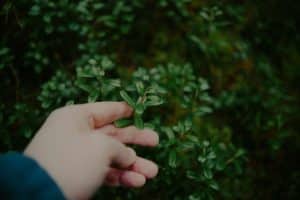
You should observe the whole plant. If you pay attention to one attractive feature such as a berry, leaf, or flower, you can make the wrong decision. Botanical analysis works best when several traits point to the same species.
Here is a step-by-step visual analysis that will help you to identify edible wild plants more effectively:
- Step 1. Confirming the habitat. Some forage plants grow near swamps, while others are found in forest shadows and open lawns. For example, the natural environment for cattail stalks is marshy ground, while blackberries are usually found along sunny woodland borders, trails, and thickets.
- Step 2. Studying the leaves. Look at whether they are opposite, alternate, basal, compound, toothed, lobed, smooth, hairy, or waxy. Leaf arrangement is one of the strongest clues because many plants keep the same basic pattern even when flowers or fruits are absent.
- Step 3. Examining flowers, fruits, stems, and roots. When examining a flower, pay attention to its shape and the petal number. If the plant has fruits, look at their color and any distinctive spots, stripes, or other visual characteristics. Regarding the seeds, stems, and roots, focus on their structure.
This method helps determine which wild plants you can eat. But it doesn’t mean that relying on visual examination is safe. You should treat identification comprehensively, including other methods. The more features you confirm, the lower the risk of misidentification.
-
Plant Identification Apps

As a hunter, you need to receive a fast second option after visual examination in the field. Plant identification apps, such as Botan AI, can be useful tools for this purpose. Combining a science-trusted plant database and AI technologies, they can recognize what greenery is growing in front of your eyes.
Everything is very simple: in Botan and other apps, the system uses the plant’s photo taken immediately on the trail to compare it with large flora databases, namely with such visible features as leaf shape, petal number, stem structure, and others. Then, it suggests possible matches.
However, such applications cannot determine whether plants in the wild are safe at a specific growth stage. Although they can be useful quick tools, you should never treat them as a 100% permission to eat plants. Poor lighting, damaged leaves, immature flowers, and a low-quality camera can all affect results.
So, use the app as a supplementary tool following a visual inspection, then confirm with a local guidebook or an experienced forager.
-
Pocket Field Guides
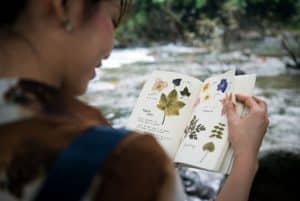
Pocket field guides are especially useful in remote hunting areas where there is no civilization and experienced foragers to give you advice nearby. Such paper helpers do not need cell service, battery life, or Internet access. A good field kit can help you recognize what plants are edible.
However, Mississippi State University Extension advises using at least three different plant resource guides for more correct identification and reducing the chance of missing a dangerous lookalike.
Before hunting, look for books that contain detailed plant descriptions, photos, drawings, habitat information, range maps, and a list of common species. We recommend that you choose guides written for your region that are more likely to include habitat notes and regional warnings.
Pocket guides can also help you build a long-term skill to identify edible plants in the wild. You should not memorize hundreds of species. Instead, begin with a small group of common, easily recognized plants.
Keep an eye on them through different seasons so you can identify separate parts first. These can be leaves, flowers, fruit, seed heads, and dormant structures.
Edible Wild Plants Comparison Chart
For quick orientation in the wild, it’s advisable to build a visual guide of the simple-recognizable, widespread, and safest wild plants in your region. The edible forest plants comparison chart below can serve as such a tool.
| Species Name | Core Visual Blueprint | Edible Parts | Best Season | Nutrient Profile | Survival Use Case |
| Wild Blackberry | Thorny red-purple trailing stems, sharply serrated leaves, white flowers, dark purple ripe berries. | Ripe berries | Summer | Natural sugars, fiber, antioxidants, vitamin C, and minerals. | Energy source. |
| Dandelion | A single yellow composite ray flower on a leafless stem, with leaves in a basal rosette. | All its parts are edible, including flower heads, young leaves, and roots. | Spring | Vitamin C, vitamin K1, fiber. | Tonic salad from leaves, tea from yellow flowers, and coffee from roasted root. |
| Cattail | Tall sausage-like brown flower spikes, long ribbon-like leaves. | Rhizomes, newly emerging shoots, pollen. | Spring
Early summer |
Starch-rich rhizomes and protein-rich pollen. | Rhizomes can be used as a starch resource, pollen as a flour substitute, and dry spikes as fire tinder. |
| Stinging Nettle | Opposite heart-shaped leaves with serrated edges, covered in fine stinging hairs. | Young leaves, stalks, roots. | Sping | Minerals and plant protein. | Salad or soup from young leaves and stalks. Roots are suitable for mineral-rich tea. |
| Pine Tree | Evergreen needles grouped in bundles, rough woody bark. | Young pine needles, inner bark. | Spring
Early summer |
Vitamin C, carbohydrates, minerals, and dietary fiber in pines and calories in woody bark. | Pine tea is widely used as a drink to prevent scurvy. Needles and woody bark are good materials for emergency fuel and shelter. |
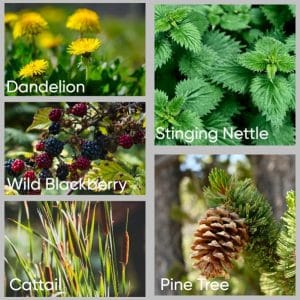
We have collected more familiar forage plants in most North American landscapes in the table. However, you can use it for learning purposes only to understand what parts are suitable for consumption and which materials can be used for emergencies.
Edible Forest Plants Harvesting Rules
Responsible forest plants harvesting is not only about knowing what species are edible. It also means ethics, ecological responsibility, and respecting local laws. Here are key edible forest plants harvesting rules you should know before hunting:
- Respecting local laws. Find out whether foraging is legal in the area where you are planning to be. After all, some conservation zones and wildlife areas may have strict rules.
- Harvesting ethics. Don’t pick everything on the trail. Take only several leaves and berries, leaving the rest for animals and insects. Avoid picking plants along with roots and rare, slow-growing, or threatened species.
- Ecological responsibility. Do not trample the area with plants, break live branches, strip bark from trees, or pollute the harvesting place.
- Life safety. If you have doubts, don’t eat the plant. Learn carefully about toxic lookalikes. Avoid harvesting on contaminated areas, such as near roadsides, railroad tracks, drainage ditches, or water that may receive agricultural runoff. Also, stop immediately if a plant causes skin irritation or unusual symptoms.
Following these rules will help you to better orient yourself in edible forest plant harvesting without violating laws, as well as harming your health and nature.
Conclusion
Knowing how to identify edible plants is a valuable skill while hunting in the wild. But information should be used in practice gradually and carefully. The safest way is combining visual botanical analysis, regional pocket guides, expert instruction, and plant identification apps.
Common edible wild plants such as blackberry, dandelion, cattail, nettle, and pine can help beginners to better understand which parts are edible and how you can use them for consumption. Still, no article, app, chart, pocket field guide, or visual analysis can guarantee that a wild plant is safe to eat in your case.
When the specific berry, grass, or other greenery looks suspicious, leave it alone, keep moving, and consider plant knowledge as a long-term survival discipline rather than a shortcut.

Per our affiliate disclosure, we may earn revenue from the products available on this page. To learn more about how we test gear, click here.

