



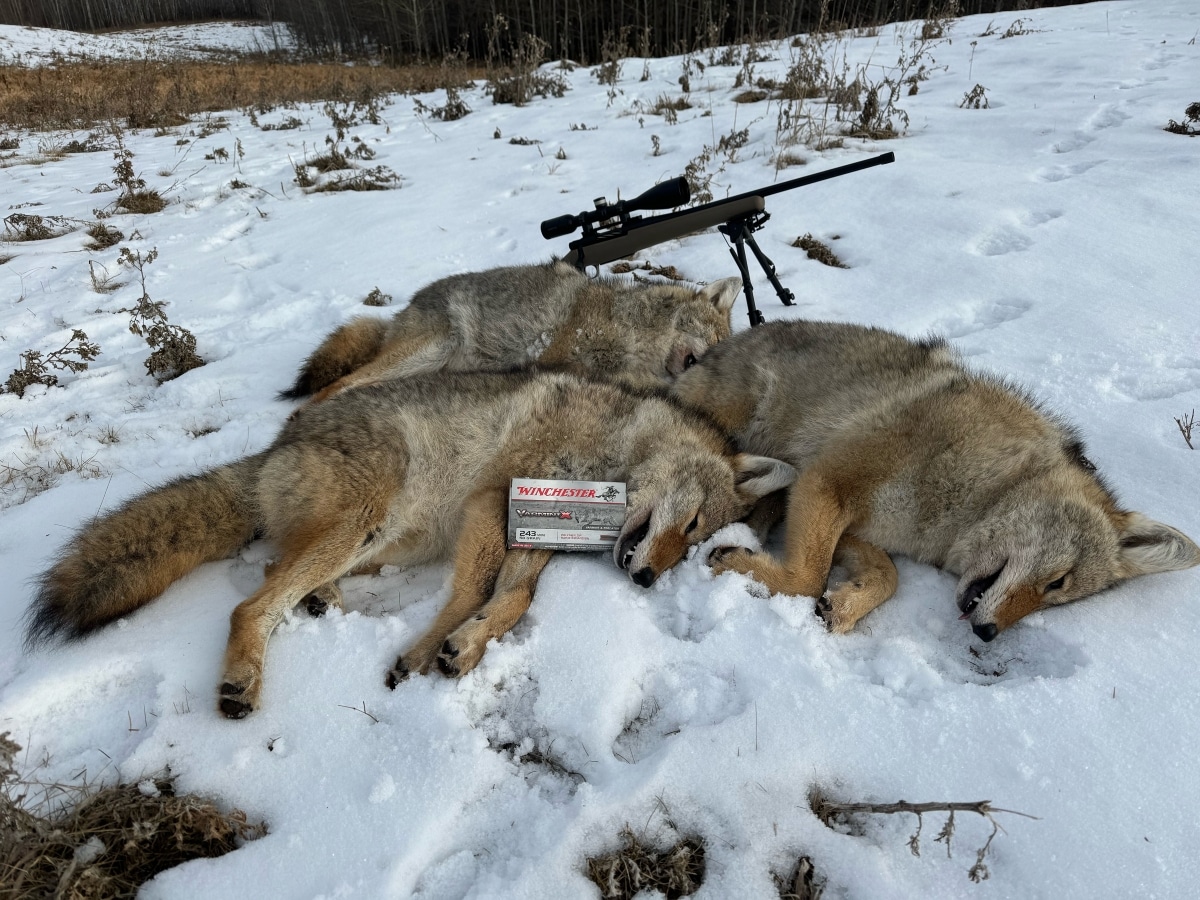
Every winter, my trail cameras capture countless photos and videos of coyotes moving through the same areas where I hunt deer. Sometimes they’re traveling alone. Other times they’re working a field edge, following a trail through the timber, or investigating an area where deer have been feeding. I’ve even captured footage of coyotes pursuing deer and carrying pieces of dead deer.
Those encounters remind me just how effective coyotes are at surviving in the wild. They are opportunistic predators with exceptional hearing, keen eyesight, and an incredible sense of smell. They can cover ground quickly, identify danger before a hunter ever realizes they’re nearby, and disappear without offering a shot.
For deer hunters looking to spend more time in the woods after the regular season, coyote hunting offers an opportunity to sharpen calling, scouting, and marksmanship skills. Coyotes can also influence local deer populations through predation, particularly on fawns, although removing individual coyotes does not automatically translate into increased deer survival.
But successfully calling coyotes is considerably more difficult than playing a rabbit distress sound and waiting for something to appear.
Over years of hunting and outfitting, I’ve watched coyotes respond to calls in nearly every way imaginable. Some charge straight toward the sound. Others circle hundreds of yards downwind. Some approach so cautiously that they’re almost impossible to spot. And plenty disappear the moment they detect something that doesn’t seem right.
Through those experiences, I’ve identified five mistakes that consistently cost hunters opportunities. Avoiding them won’t guarantee success, but it can dramatically improve how you approach each stand.
Here’s what I’ve learned about calling coyotes, choosing the right setup, managing wind and scent, and knowing when to stay put.
The Quick Answer
Successful Coyote Hunting Comes Down to the Details
Pay attention to wind direction, control your calling volume, avoid contaminating coyote travel routes, use a dependable shooting rest, and give cautious predators enough time to respond.
Those five principles form the foundation of a successful calling setup, whether you’re hunting snowy farm country, brushy creek bottoms, or heavily wooded terrain.
Coyote Hunting Tips From the Field
Watch the video below for additional perspective on coyote hunting and calling tactics. Then use the guide that follows to understand the mistakes that can cause a wary predator to disappear before you ever get a shot opportunity.
Jump to a Section
Ignoring the Wind: The Fastest Way to Ruin a Coyote Hunt
If there’s one lesson every new coyote hunter should learn, it’s that you aren’t going to beat a coyote’s nose.
Coyotes have excellent eyesight and hearing, but their sense of smell is often what ultimately determines whether they commit to a call. A predator responding to a wounded-rabbit sound isn’t necessarily going to charge straight into the open. Many will approach cautiously, studying the terrain and attempting to get downwind of whatever is making the noise.
I’ve watched coyotes circle a calling setup from considerable distances, using every bit of available cover as they work toward a position where the wind can tell them whether something is wrong.
When a coyote reaches your scent stream, the hunt can end almost instantly.
Set Up With the Wind in Your Favor
Whenever possible, I like to position myself so I can watch the area a coyote is most likely to use while approaching or circling the call.
That often means setting up with a crosswind or with the wind generally in my face, rather than allowing my scent to blow directly into the cover where I expect coyotes to be holding.
The exact setup depends on the terrain. In open agricultural country, I may have several hundred yards of visibility. In wooded areas or brushy draws, I might have only a narrow shooting lane.
Either way, the principle remains the same: anticipate how a coyote can use the wind and position yourself to detect its approach before it detects you.
Whenever I hunt familiar properties, I think about where the coyotes are likely to be holding, which cover they might use, and how they could circle the caller.
If a direct setup doesn’t offer a usable wind, I’ll look for a crosswind alternative. The important thing is having enough visibility to recognize an approaching coyote and respond without making unnecessary movement.
Kevin’s Field Tip: Plan for a Downwind Approach
Don’t assume a coyote will approach the caller in a straight line. Before starting a stand, identify the most likely downwind approach route and make sure your position provides a clear view of that area.
Why Terrain Matters as Much as Wind
One of the biggest advantages experienced coyote hunters have is knowing the properties they hunt.
On many of my familiar setups, I have a good understanding of where coyotes spend time and which routes connect woodlots, drainages, and open fields.
That information influences where I place my caller, how I approach the stand, and the direction I expect a responding coyote to travel.
When visibility is limited, I try to use natural openings, field edges, and other terrain features to improve my chances of seeing an approaching animal.
Even with careful planning, some coyotes will manage to circle behind you and catch your scent. But understanding how the wind and terrain work together can prevent many avoidable mistakes.
Calling Too Loudly: Why More Volume Isn’t Always Better
One of the most common mistakes I see is hunters assuming that a louder call will always bring more coyotes.
I understand the temptation. When nothing responds, it’s natural to think that increasing the volume will help the sound reach farther.
Sometimes more volume is appropriate, particularly when you’re calling across large areas or dealing with wind. But coyotes have exceptionally sensitive hearing, and a sound that seems reasonable to us may be much louder than necessary at close range.
Think about the sounds made by real prey animals. A wounded rabbit or a mouse moving beneath the snow isn’t necessarily producing an overwhelming amount of noise.
The goal is to create a convincing calling situation, not simply the loudest one possible.
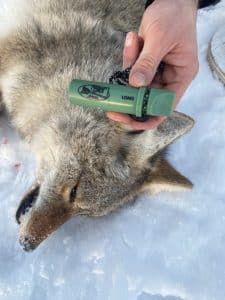
Prey distress mouth calls can be effective for attracting coyotes when used with realistic volume and timing.
Start With a Realistic Calling Sequence
I’ve experimented with call volume under a wide range of conditions, and one thing has become clear: there isn’t one setting that works everywhere.
On crisp, calm winter mornings, sound can seem to travel tremendous distances. On windy days, the same call may be much harder to hear from far away.
When I’m calling in relatively calm conditions, I generally prefer to begin at a controlled volume and increase it only when the situation calls for it.
If a coyote appears and begins approaching, I watch its behavior closely.
When an animal is coming toward the sound with confidence, there may be little reason to keep the call playing loudly. In some situations, I gradually reduce the volume as the coyote gets closer.
I’ve watched coyotes suddenly become nervous and retreat when distress sounds remained unnecessarily loud at close distances.
Reading the animal’s body language is often more useful than following a rigid calling formula.
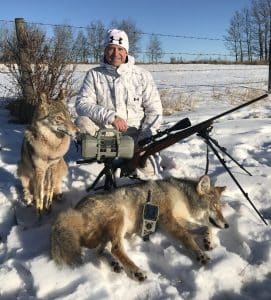
Electronic callers provide access to multiple sounds and allow hunters to adjust calling volume. Kevin has used a FOXPRO Shockwave as one of his preferred calling setups.
Choosing an Electronic Coyote Call
Electronic predator callers offer several advantages, particularly when it comes to sound selection and precise volume control.
I’ve used multiple electronic calls over the years, and FOXPRO has been among my favorites. The ability to change sounds and make small volume adjustments allows me to respond to the circumstances without moving around unnecessarily.
A good electronic caller also lets hunters position the sound source away from where they’re sitting, which can be useful when a coyote focuses its attention on the calling location.
FOXPRO Electronic Predator Call
For hunters who want a wide selection of predator sounds and adjustable volume, a FOXPRO electronic caller is worth considering. Kevin’s experience with FOXPRO calling equipment highlights the value of managing sound levels rather than simply running every calling sequence at maximum volume.
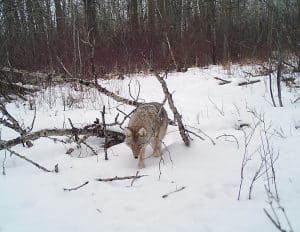
Coyotes frequently approach calling setups cautiously, using their senses to identify anything that appears unnatural.
Kevin’s Field Tip: Watch the Coyote, Not Just the Caller
If a coyote is approaching confidently, consider gradually reducing your calling volume. Watch for changes in its posture, direction, and speed. The animal’s reaction can tell you more than a preset calling sequence.
Walking Through Coyote Trails Before You Start Calling
Winter coyote hunting presents an opportunity that isn’t always available during the rest of the year: snow can reveal exactly where coyotes have been traveling.
When the ground is covered with several inches of snow, well-used trails can become relatively easy to identify. Coyotes, like people, often use routes that require less energy to travel.
That might mean a packed trail through timber, a frozen creek bottom, an old logging road, or a narrow opening between patches of cover.
The temptation is to follow those paths because they’re easier to walk.
Unfortunately, that can be a serious mistake.
Your Entry Route Can Give You Away
Even hunters who use scent-control products leave human odor behind.
Every step deposits scent along the ground, and brushing against vegetation can leave additional evidence of your presence.
If a coyote follows a familiar route and suddenly encounters a fresh human track, it may become suspicious or leave before you ever see it.
I’ve made that mistake myself.
On properties where I know the main coyote travel routes, I’ve watched animals react immediately after encountering an area where I’d walked earlier.
It’s frustrating because the calling setup itself may have been excellent. The mistake happened before the first sound was ever played.
Use Natural Travel Corridors Without Contaminating Them
One of my favorite winter calling situations involves steep-sided drainages and frozen creek bottoms.
When snow gets deep, coyotes frequently take advantage of easier travel routes, including packed paths and stretches of frozen creek where footing allows.
I’ve had good success identifying those corridors and choosing calling positions that provide visibility toward them.
The important part is approaching the stand without walking directly through the route you’re hoping coyotes will use.
Whenever possible, I plan my entry so I can reach a calling position without leaving a fresh human scent trail across the likely approach.
Kevin’s Field Tip: Scout the Trail, Then Stay Off It
Use snow to identify heavily traveled routes, but avoid walking those routes when entering a calling stand. Think about where a responding coyote will travel and keep your scent and movement away from that approach whenever practical.
Avoid Overhunting Productive Calling Locations
Another common mistake is returning to the same calling location too frequently.
Coyotes that survive encounters with hunters may become more cautious around familiar sounds, vehicles, access routes, and areas where they’ve experienced pressure.
Rather than repeatedly calling the same opening without considering what happened on previous hunts, rotate locations when practical and pay attention to how coyotes respond.
Sometimes a different entry route, calling position, or wind direction makes a productive property worth hunting again.
Not Using a Stable Shooting Rest
I’ve seen hunters do nearly everything right during a coyote stand, only to miss when an animal finally presents a shot.
They chose a good calling location, managed the wind, and brought a coyote into view. But when it came time to shoot, they tried to hold the rifle steady without adequate support.
Coyotes present relatively small vital areas, and accurate shot placement becomes more difficult when an animal is standing on uneven ground or the hunter is trying to shoot from an awkward position.
As a professional outfitter and guide, I’ve consistently encouraged hunters to carry a dependable shooting rest.
There are several effective options, including bipods, tripods, and adjustable shooting sticks. The best choice depends on terrain, shooting position, and personal preference.
Why Adjustable Support Matters
One challenge hunters often underestimate is the amount of variation between shooting positions.
A fixed-height bipod may work perfectly from a level field but become awkward when the hunter is positioned in a drainage and the coyote appears higher on a hillside.
I once watched a hunter spend nearly two minutes trying to adjust his position around a bipod that was simply too short for the uphill shot he was facing.
The coyote stood approximately 60 yards away, but the hunter couldn’t establish a comfortable, stable position.
That experience reinforced something I’ve seen many times: a shooting rest needs to work with the terrain, not just look good on a flat shooting bench.
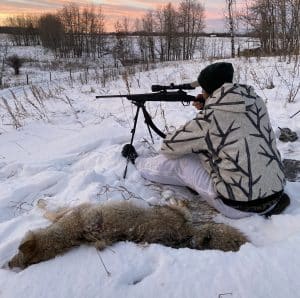
An adjustable shooting rest can help hunters maintain a stable position on uneven winter terrain.
The Shooting Rest I Prefer
I’ve used monopods, shooting sticks, and various bipods over the years. All can work when matched to the conditions.
For many of my coyote setups, I prefer an adjustable swivel-mount bipod that allows me to compensate for uneven ground.
One of my longtime choices has been the Harris S-25C bipod. Its adjustable legs extend from 13.5 to 27 inches, and the swivel design helps accommodate sloped terrain.
That flexibility matters when a coyote appears in a location that requires a different shooting angle than the one you initially anticipated.
Harris S-25C Bipod
Kevin favors the adjustable Harris S-25C for its extendable legs and swivel capability, which can help accommodate uneven terrain during a coyote hunt.
Whatever shooting support you choose, practice with it before heading afield and only take shots when you can maintain safe, confident control of the rifle.
A Word About Shot Distance
Long-range opportunities require careful judgment. A clear view of a coyote doesn’t automatically mean an ethical shot is available. Distance, wind, shooting position, equipment, and the hunter’s demonstrated accuracy all matter. If you cannot confidently place the shot or identify a safe backstop, pass on the opportunity.
Leaving a Calling Stand Too Soon
Of all the mistakes I’ve seen coyote hunters make, leaving a productive stand too early might be the most frustrating.
It’s understandable. You’ve been sitting in freezing temperatures, playing distress sounds, and watching the same patch of timber for 20 minutes without seeing anything.
At some point, you start wondering whether it’s time to move.
But coyotes don’t follow a schedule.
Some respond within minutes. Others take their time, approaching cautiously or stopping repeatedly to evaluate the situation.
I’ve watched coyotes appear after 35 or 40 minutes of calling. On occasion, I’ve had them show up even later.
How Long Should You Call From One Location?
There’s no perfect answer because each calling setup is different.
When I have good visibility, know coyotes are likely to be nearby, or am working an area where an animal could approach from a considerable distance, I often plan to remain for approximately 45 minutes.
Other hunters prefer shorter stands, sometimes moving after 15 or 20 minutes without a response.
Shorter stands may be practical when hunting large areas and trying to cover more ground. But in places where coyotes can approach cautiously through thick cover, patience can be especially valuable.
The important thing is considering the terrain and the likelihood of a delayed approach before deciding to leave.
The Coyote That Showed Up After We Quit
One experience still stands out.
My partner and I were set up on a shallow hill roughly 90 yards from a large willow bluff where I knew coyotes occasionally spent time.
The visibility was excellent. We could see several hundred yards across an open field, and a stiff crosswind was blowing.
After about 30 minutes of calling, I hadn’t seen a thing.
Eventually, I decided there probably weren’t any coyotes around. We stood up and started gathering our gear.
Then I looked over my shoulder.
There, roughly 250 yards away, was a lone coyote trotting toward us.
By the time I realized what was happening, the animal had already spotted our movement.
The opportunity was gone.
That experience was another reminder that a quiet calling stand isn’t necessarily an unsuccessful one. Sometimes a coyote is approaching long before you know it’s there.
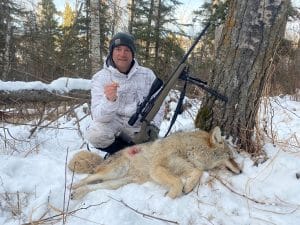
A coyote photographed during one of Kevin’s hunts. In this instance, the animal was approximately 477 yards away, illustrating the long distances at which coyotes may appear. Such shots should never be attempted without the necessary skills, conditions, and a safe backstop.
Watch for Coyotes That Stop and Study the Setup
Another reason to remain patient is that not every responding coyote continues moving directly toward the caller.
Some will approach to the edge of cover, stop, sit down, and listen before moving any farther.
This can be particularly common in areas where coyotes have experienced substantial hunting pressure.
If you’re watching only the most obvious trail or opening, you may overlook an animal standing motionless in the brush.
Take time to scan likely approach routes and the edges of cover without making unnecessary movements.
Kevin’s Field Tip: Give the Stand Time to Work
When the terrain and visibility justify it, don’t be afraid to remain on a calling stand for 40 to 45 minutes. Coyotes may be responding slowly, circling through cover, or evaluating the sound from a distance.
Coyote Hunting Mistakes at a Glance
These are the five principles I’d focus on before making your next winter coyote stand.
Additional Coyote Hunting Tips for Winter
Wind, calling, approach routes, shooting support, and patience are the foundation of a successful coyote hunt. But there are other details worth considering as well.
Learn the Property Before You Hunt
Spend time identifying likely travel corridors, bedding cover, frozen creek crossings, and field edges that provide good visibility.
The more you understand how coyotes use a property, the easier it becomes to choose calling setups that give you a reasonable opportunity to see an approaching animal.
Pay Attention to Hunting Pressure
Areas that receive frequent calling pressure may produce more cautious responses. Coyotes that have encountered hunters before can become reluctant to expose themselves in open terrain.
Consider how frequently an area has been hunted and whether a different location or approach would be more productive.
Use the Right Sounds for the Conditions
Prey distress sounds are popular for a reason, but they aren’t the only option. Depending on the season and circumstances, hunters may also experiment with coyote vocalizations and other sounds available on their electronic callers.
No single sound works every time. The important thing is choosing realistic sequences and paying attention to how coyotes respond.
Know the Rules Before You Go
Coyote hunting regulations vary by state and may include rules governing hunting seasons, legal hours, electronic calls, artificial lights, firearms, and hunting methods.
Always review current regulations for the state and property you’re hunting before heading out.
Frequently Asked Questions About Coyote Hunting
How long should you call for coyotes?
There is no universal calling duration. Kevin often allows approximately 45 minutes when visibility, terrain, or known coyote activity justify a longer stand. Some coyotes respond within minutes, while others approach much more cautiously.
What is the best wind direction for coyote hunting?
A crosswind or a setup with the wind generally in the hunter’s face can work well, depending on terrain. The goal is to keep human scent away from likely approach routes while maintaining visibility of areas coyotes may use to circle downwind.
Should you start coyote calling at full volume?
Not necessarily. In relatively calm conditions, a moderate starting volume may be more realistic. Higher volume can be useful for reaching farther across open or windy terrain. Watch approaching coyotes and adjust according to their behavior.
Why do coyotes circle downwind of a call?
Coyotes often use their sense of smell to investigate possible food sources and evaluate danger. Moving downwind of a distress sound can help them determine whether the situation is safe.
Is winter a good time to hunt coyotes?
Winter can provide useful hunting conditions because snow reveals travel routes, vegetation may offer greater visibility, and many hunters have more time available after deer season. Success still depends on local coyote activity, weather, terrain, and hunting pressure.
Do you need an electronic caller to hunt coyotes?
No. Mouth calls can be highly effective. Electronic callers offer advantages such as multiple sound selections, adjustable volume, and the ability to position the sound source away from the hunter.
Does coyote hunting help deer populations?
Coyotes can affect deer survival, particularly fawn recruitment, in some locations. However, hunting coyotes does not automatically result in increased deer populations. Outcomes depend on habitat, deer abundance, other predators, and the timing and intensity of predator management.
Final Thoughts: Successful Coyote Hunting Is About the Little Things
After years of hunting coyotes and guiding other hunters, I’ve learned that success rarely comes down to one magic call, one perfect stand, or one piece of equipment.
It’s usually the result of making a series of good decisions.
Choose a calling setup that accounts for the wind. Approach without contaminating the routes coyotes are likely to use. Match your calling volume to the conditions. Carry dependable shooting support. And above all, don’t assume a quiet stand means nothing is coming.
Some of my most memorable coyote hunting experiences have involved animals that approached cautiously, circled from unexpected directions, or appeared much later than I anticipated.
Those experiences taught me to slow down and pay attention.
Coyotes survive by noticing details that other animals might overlook. To consistently call them into range, hunters need to develop that same attention to detail.
The next time you’re sitting in a frozen field or watching a snow-covered creek bottom, remember that the smallest decisions you make before and during a calling stand can have the biggest impact on what happens next.
Hunt the wind, keep your movements controlled, be patient, and let the experience teach you something every time you go afield.
More Predator Hunting Advice
Want to continue improving your approach? Read our Coyote Hunting Tips and Tactics guide for additional predator hunting information.
For hunters spending long hours in freezing conditions, our Best Cold Weather Hunting Boots guide covers insulated footwear for winter hunting.
Editorial note: This article incorporates field observations and hunting advice from veteran hunter and outfitter Kevin Wilson. Individual hunting experiences are not guarantees of future results. Product availability and specifications may change. Always follow applicable hunting regulations and safe firearm-handling practices.

Per our affiliate disclosure, we may earn revenue from the products available on this page. To learn more about how we test gear, click here.

