




Best Heated Hunting Clothing & Gear
Freezing hands, numb toes, and a chilled core shorten more hunts than busted wind or bumped deer. Modern heated hunting apparel fixes that. Battery-powered warmth, placed exactly where you need it, lets you sit longer, move quieter, and stay focused when late-season temps bite. Below you’ll find our testing notes, category winners, and quick-hit pros and cons to help you build a warm, efficient system that actually works in the field.
How We Tested

Since clothing is such a user experience thing and has such high variation among users, we asked several of our outdoor writers for input and polling to put together the ultimate list. After, we evaluated each piece in subfreezing, late-season whitetail conditions with a mix of long treestand sits and short hikes. Our scoring prioritized warmth (time-to-heat and evenness), battery life on low/medium/high, comfort under real hunting layers, weather resistance, noise, dexterity (for gloves), and ease of use (controls, charging, spare batteries). Gear that layered cleanly, stayed quiet, and delivered reliable warmth at realistic runtimes rose to the top. Click the orange to see why it was chosen – click the green to shop.
The Winners
- Best Heated Socks: Lenz Heated Socks 5.1 Toe Cap
- Best Heated Vest: Fieldsheer APX Heated Vest
- Best Heated Gloves: TideWe Heated Hunting Gloves
- Best Heated Jacket: TideWe Heated Hunting Jacket
- Best Heated Thermals/Base Layers: Fieldsheer Heated Base Layers
- Best Heated Treestand Seat for Hunting: Kemimoto Hunting Seat Cushion
- Best Heated Blind Seat for Hunting: Kemimoto Heated Hunting Blind Chair
Best Heated Socks for Hunting: Lenz Heated Socks 5.1 Toe Cap

The Lenz Heat Sock 5.1 Toe Cap Slim Fit blends high-performance materials with smart heating design—targeting the full toe box from above and below using a carbon fiber “toe cap” element, while maintaining a slim profile that fits comfortably in hunting boots. Its knitted blend of merino, silk, and technical fibers offers breathability and moisture control, and the leg cuff employs a bandage-style support to keep things snug without cutting circulation. Heat settings are controlled via the battery module or optional app, which supports multiple levels and even interval modes. In field testing and independent reviews, users report that at lower settings the socks can last all day.
Pros:
-
Excellent toe heat coverage (top and bottom)
-
Slim fit that works well in hunting boots with minimal bulk
-
High-quality materials that manage moisture and stretch
-
App control and interval setting give flexibility and power savings
-
Batteries can last a full day (on lower settings)
Cons:
-
At highest settings, runtime shrinks significantly
-
Heating output is modest compared to expectations
-
The battery module must be tucked or folded under the cuff, which might slightly alter fit
-
The app requires registration before use which can be annoying to some or a hindrance on low service areas
-
In very cold temps or in wet conditions, these may need to be paired with insulation or layering
Best Heated Vest for Hunting: Fieldsheer APX Heated Vest
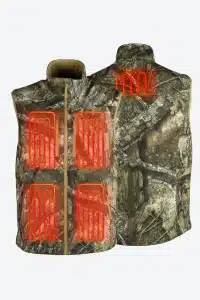
The Fieldsheer APX Realtree Heated Vest earns our pick as the best heated vest for hunting because it combines serious heating performance with features specifically designed for the field. Instead of feeling like a general-purpose heated vest adapted for hunters, the APX is built around concealment, quiet movement, layering, and long sits in cold weather.
Fieldsheer uses a five-zone heating system with heating elements positioned across both sides of the chest, both front hand-pocket areas, and the upper back. Four adjustable heat settings range from 90°F to 135°F, letting you run it low during a long sit or turn the heat up when temperatures really drop. The included 7.4V 4000mAh Powersheer XL battery can provide up to 8+ hours of heat on the lowest setting, although runtime drops to roughly two hours when running continuously on high.
What separates the APX from many heated vests is the hunting-focused construction. The outer shell is a quiet four-way stretch polyester fabric finished with a durable water-repellent treatment, while a breathable grid-fleece lining adds passive warmth without making the vest excessively bulky. Fieldsheer also incorporates Polygiene odor control, which is a worthwhile feature for whitetail hunters trying to minimize human scent.
The Realtree APX camo pattern allows the vest to work as an exposed outer layer during milder weather, but its relatively streamlined profile also makes it easy to wear beneath a heavier hunting jacket when temperatures fall. Heat can be adjusted using the waterproof control button or through Fieldsheer’s MW Connect Bluetooth app, including from a compatible smartphone or smartwatch.
For treestand hunters in particular, we like the combination of direct core heat, quiet materials, long low-setting runtime, and heating elements around the hand pockets. Rather than adding another bulky insulating layer, the APX lets you add warmth where it matters and adjust it as conditions change.
Pros:
- Five heating zones cover the chest, upper back, and both front hand-pocket areas
- Four heat settings ranging from 90°F to 135°F
- Up to 8+ hours of battery life on the lowest setting
- Quiet four-way stretch shell is better suited to hunting than many general-purpose heated vests
- Realtree APX camouflage works as either an outer layer or part of a layering system
- DWR finish helps shed light rain and snow
- Polygiene odor-control treatment is useful for whitetail hunting
- Bluetooth control through the MW Connect app
- Battery is included with the vest
- Grid-fleece lining provides warmth even when the heating system is turned off
Cons:
- At $199.99, it is considerably more expensive than many entry-level heated vests
- Runtime falls to roughly two hours when continuously used on the highest setting
- A 4–5 hour recharge time means carrying a spare battery makes sense for extended hunts
- The battery adds some weight and bulk compared with a traditional unheated vest
- DWR provides weather resistance, but this is not a replacement for a waterproof outer shell in sustained rain
- Bluetooth control is convenient but unnecessary for hunters who prefer simple button-operated gear
Best Heated Gloves for Hunting: TideWe Heated Hunting Gloves

The Tidewe Camo Waterproof Heated Hunting Gloves are built for hunters needing warmth, dexterity, and concealment. These gloves feature a camo-patterned, waterproof outer shell, internal heating elements across the fingers and back of hand, and three adjustable heat settings. Their rechargeable battery system supports several hours of use (varies by setting), and the glove design balances insulation with control so you can safely handle triggers. The cuffs are built to seal out wind and cold, and the materials aim to reduce noise during movement — key features for hunting use.
Pros:
-
Waterproof shell suitable for wet or dewy conditions
-
Camouflage design improves concealment in hunting environments
-
Multiple heat settings give flexibility for changing conditions
-
Balanced insulation so fingers stay warm but grip control is maintained
-
Quiet materials and low-noise design help reduce detection
Cons:
-
On high heat, battery runtime drops steeply
-
Bulkier than ultra-minimalist gloves—may feel slightly clunky for precise shots
-
Battery placement (at cuff or wrist) can slightly interfere with layering or sleeves
-
In extreme cold or wind, additional layering may still be needed
-
Over time, wiring/connectors are potential weak points (as with all heated gear)
Best Heated Jacket for Hunting: TideWe Heated Hunting Jacket

The TIDEWE Heated Jacket is a battery-powered outer layer designed for cold weather and outdoor activities. It features three heat zones (chest, upper back, and lower back) that you can toggle with a button, typically offering low, medium, and high settings. The jacket uses a rechargeable battery pack (often 7.4 V or 12 V, depending on model) and supports runtimes from several to many hours (depending on which setting you use). It’s built with a windproof and water-resistant outer shell, and includes zippered pockets to store the battery and any gear. Its design is geared more toward general outdoor use — snow, hiking, commuting — than specifically stealth or silent movement; but in moderate cold conditions, it can be a solid choice for hunters on tighter budgets or as a backup layer.
Pros:
-
Multiple heat zones (chest, upper and lower back) for distributed warmth
-
Decent runtime on low or medium settings (battery allows flexibility)
-
Zippered pockets help keep battery and electronics secure
-
Windproof and often water-resistant shell helps in variable weather
-
More affordable than many premium heated jacket options
Cons:
-
Not camo — standard color shells may stand out in hunting environments
-
Material may not be as quiet or stealthy under movement as purpose-built hunting jackets
-
High settings drain battery quickly, reducing runtime significantly
-
Bulk of battery and wiring may interfere with tight layering or pack carry
-
May need supplemental insulation or layering in very cold/rugged hunts
Best Heated Thermals/Base Layers for Hunting: Fieldsheer Heated Base Layers
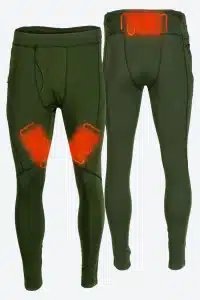
For cold-weather deer hunting, we like the Fieldsheer Primer Heated Base Layer Shirt and Pants because they put active heat exactly where a base layer can make the biggest difference: close to the body and underneath the rest of your insulation.
The Primer system gives hunters a heated top and bottom that can be worn together or independently depending on conditions. The shirt uses three heating zones, with two across the chest and one on the back. The pants also use three heating zones, placing warmth across both thighs and the lower back. That coverage works particularly well for treestand hunting, where your core and legs can get cold quickly once you stop moving.
Both pieces use Fieldsheer’s Mobile Warming heating technology with thin, flexible heating elements designed to provide warmth without turning your base layer into a bulky garment. Each piece is rated for up to nine hours of heat per charge, making the Primer system practical for long morning or evening sits. The rechargeable battery and charging cable are included.
Heat can be adjusted directly from the garment or through Fieldsheer’s Bluetooth-enabled MW Connect system. That gives you the option to change the temperature without digging through layers once you’re settled into a stand.
The biggest advantage of heated base layers is how efficiently they fit into an existing cold-weather system. Instead of relying entirely on thicker insulation, the Primer top and bottom create warmth at the first layer. Add your normal insulating mid layers and hunting outerwear over them, and that heat is easier to retain.
For hunters who spend hours sitting still in late-season conditions, the combination of heated chest, back, thighs, and lower back coverage makes the Fieldsheer Primer system one of the more complete heated layering options we’ve found.
Pros:
- Matching heated shirt and pants create a full upper- and lower-body system
- Shirt has three heating zones across the chest and back
- Pants heat both thighs and the lower back
- Up to nine hours of runtime per charge
- Thin heating elements minimize unnecessary bulk
- Bluetooth-enabled wireless temperature control
- Battery and charging cable included with each garment
- Machine washable after removing the battery
- Can be worn separately depending on temperature and hunting conditions
- Particularly useful for long, stationary late-season hunts
Cons:
- At $159.99 per piece, buying the complete shirt-and-pant system is a substantial investment
- The shirt and pants each require their own battery
- Maximum runtime depends heavily on the heat setting being used
- Batteries add some weight compared with conventional thermal underwear
- Hunters who walk long distances may not need active heat until they reach their stand
- For maximum efficiency, the layers need to fit relatively close to the body
Best Heated Treestand Seat for Hunting: Kemimoto Hunting Seat Cushion

The Kemimoto Heated Hunting Seat Cushion is a portable, camo-patterned pad built for long sits in tree stands or blinds. It integrates dual heating plates (one in the seat, one in the backrest) powered by a 10,000 mAh rechargeable battery, giving you up to 6 hours of heat on low setting (shorter durations on higher settings). The cushion is also designed with a “light-out” feature, meaning the heating function remains active even when the display light is off — helping maintain stealth in low-light or night sits. Kemimoto is built in quiet fabrics (poly-cotton blend) and has adjustable straps so the pad can be strapped onto tree stands or ladder steps without rattling.
Pros:
-
Heats both your seat and back for more even warmth
-
Up to ~6 hours runtime on low (medium/high last shorter)
-
Camouflage design blends into natural surroundings
-
Quiet fabric and “light-out” mode reduce detection risk
-
Adjustable straps help keep the cushion in place in stands or ladders
Cons:
-
High heat settings drain the battery quickly (4 hr or less)
-
Bulk and wiring may affect how snugly it fits in tight seats
-
Battery must be protected from extreme cold or damage
-
Dual heating can mean increased power draw (less runtime overall)
-
Not a full replacement for heated clothing — ideally supplemental
Best Heated Blind Seat for Hunting: Kemimoto Heated Hunting Blind Chair

The KEMIMOTO 20,000 mAh Heated Hunting Seat Cushion is a rugged, camouflage-patterned pad designed for long sits in blinds or tree stands. Its high-capacity 20,000 mAh battery promises up to 8 hours of continuous heating on the lowest setting (shorter at higher levels). The cushion features dual heating zones (seat and back), quiet fabric construction, and a “light-out” mode so the visible display doesn’t give away your position in low light. It’s contoured and padded for comfort, and includes adjustable straps so you can secure it neatly to ladder rungs, treestand seats, or bench surfaces. The KEMIMOTO cushion is meant to be a supplemental heat source for your core and lower body—especially beneficial during long, cold sits when floorboards or metal seats radiate cold upward.
Pros:
-
High-capacity 20,000 mAh battery offers longer potential runtime than many heated cushions
-
Dual heating panels (seat + back) for more even warmth distribution
-
Camouflage design helps with concealment in hunting environments
-
Quiet fabrics and stealth mode reduce light/noise signature
-
Adjustable straps allow stable mounting on a variety of stand or seat surfaces
Cons:
-
On mid or high settings, runtime will drop significantly (likely 3–5 hours)
-
Bulk and wiring may interfere in compact or tight tree-stand seats
-
The weight of the battery plus cushion may add noticeable load in your pack
-
In very cold temps, battery efficiency will drop — the real runtime may be lower
-
As with any external gear, connectors, wires, or battery can fail; it should be viewed as a supplement, not a replacement, for heated apparel
Future Trends: What’s Next in Heated Hunting Apparel & Gear
As battery tech, materials science, and smart wearable systems continue to advance, heated hunting gear is poised for several major evolutionary shifts. Here are key trends to watch (and potentially capitalise on) in the coming years:
Smarter, Adaptive Heating with AI & Sensors
Garments will increasingly include built-in sensors that monitor skin temperature, ambient temperature, movement, and even blood flow. Using AI or algorithmic control, heated garments will dynamically adjust heat levels without user input—boosting warmth when needed and conserving battery when not.
Integration with Wearables & Connectivity
Bluetooth and app control are no longer “extra” — they’re becoming standard. Expect heated gear to communicate with your watch, GPS, or smart jacket, enabling temperature presets, usage logging, and even alerts when battery is low or heating fails.
Wireless / Textile Charging & Energy Harvesting
One of the most exciting innovations is embedding wireless-charging textile coils into garments. These coils could allow your heated vest or base layer to recharge when placed on a compatible mat or device, eliminating the need to plug in wires. Recent research demonstrates textile coils for body-scale wireless charging.
Similarly, energy harvesting (e.g. solar or kinetic) will help top off batteries in the field. Some current research already explores solar-powered heated apparel.
A group using several heated garments can go through rechargeable batteries quickly. For multiday hunts, a portable power station for camp can recharge heated vests, socks, gloves and seat cushions without running a generator.
Ultra-Thin, Flexible Heating Materials
As conductive materials improve, manufacturers can make heating elements more flexible, lighter, and stretchable. This leads to garments that feel more like regular clothing with embedded warmth. Some future textiles may even be fully seamless in heat integration.
Sustainability & Eco Materials
Consumer demand is pushing heated apparel toward greener manufacturing. Trends include recyclable battery systems, biodegradable insulation, recycled fabrics, and energy-efficient heating circuits to reduce total power draw.
Expansion into New Use Cases & Therapies
Heated clothing extends beyond outdoor recreation into medical, therapeutic, and occupational applications: relief for arthritis or circulatory issues, heated uniforms for cold-environment jobs, and wearable heat in extreme climate zones.
Standardization & Interoperability
As more brands enter the heated-gear space, standard battery interfaces, connectors, and communication protocols will become more common. That means better cross-brand compatibility (e.g. use a battery from one vest in another jacket) and easier adoption.
Conclusion

A smart heated system beats any single bulky garment. For maximum versatility, start with heated base layers and a heated vest — the Pnuma Heated Core lineup covers both with low-bulk warmth that plays well under quiet, wind-resistant outerwear. Add heated socks to save your toes, gloves to keep fingers nimble, and a heated jacket for the deepest cold. Manage heat on low/medium, carry extra batteries, and you’ll hunt longer, steadier, and more comfortably when late-season weather turns brutal.

Per our affiliate disclosure, we may earn revenue from the products available on this page. To learn more about how we test gear, click here.

